
Annapurna Circuit Trek Cost: A Complete Budget Breakdown
What the Annapurna Circuit costs in 2026 — permits at official tariffs, the now-mandatory guide, teahouse days, road transfers and flights, with every planning estimate flagged.

The circuit's costs, and why they are hard to quote
The Annapurna Circuit is the hardest of Nepal's famous treks to put a single price on, for a structural reason: the walk is no longer one fixed thing. Road building along the valley has turned the classic route into a menu — trekkers now choose where the walking starts and where a jeep takes over, which means the same "Circuit" can run from ten days of walking with transfers to three weeks on foot the old way. Every cost scales with that choice: more walking days means more teahouse bills and more guide days; more jeep means less of both plus a transport fare.
So this breakdown works the honest way. First the fixed items — permits and insurance-style paperwork, which are official tariffs and do not move. Then the daily items — guide, rooms, food — quoted as ranges with their source and flagged where they are planning estimates rather than figures gathered for this route specifically. Then the transport items, and finally assembled totals for the common shapes of the trek. Where a number is an estimate built from Everest-region data or general teahouse pricing, the text says so; no figure on this page is presented as more researched than it is.
The fixed costs: permits
Two documents are non-negotiable on the Circuit, and both are official tariffs. The Annapurna Conservation Area Permit (ACAP) is NPR 3,000 for foreign visitors — one fee covering the whole conservation area, from the trailhead through the Thorong La pass to the descent, valid for the single entry. The TIMS card is NPR 2,000 for foreign trekkers, issued through a registered trekking agency. That is NPR 5,000 of paperwork, roughly US$37 at recent exchange rates, and it is the same for a ten-day walk as a twenty-day one.
The third document is the guide, and since the Nepal Tourism Board's rule of 31 March 2023 the guide is not optional on this route: the Annapurna Circuit is on the published list of treks requiring a licensed guide and an agency-issued TIMS card, checked at the trailhead. Guides cost roughly US$25-35 a day on 2026 operator quotes. On a twelve-day walk that is US$300-420; on a longer, slower circuit it scales upward linearly. Agencies bundle the guide, the TIMS card and the ACAP purchase together, which is also the only way the card can be issued.
The daily costs on the trail
The Circuit is a teahouse trek: you sleep in lodges along the route and eat in their dining rooms, and the daily bill has two parts. Rooms on the Annapurna teahouse trails are commonly NPR 500-2,000 a night at 2026 operator quotes — modest sums, because the lodge's profit is understood to come partly from the food and the extras.
Food is the bigger daily line, and here the honest sourcing note matters. On the Everest route, operators quoted US$25-40 per day for food in 2026; the Annapurna Circuit sits lower for two structural reasons — its trail never spends as many consecutive days at Everest's altitudes, where every sack of flour arrives by porter or helicopter, and its route is now stitched to roads along much of its length, which shortens the resupply chain. A realistic planning estimate for Circuit food, built from those facts rather than from an Annapurna-specific survey, is US$20-35 per day, with the upper end in the high country between Manang and Muktinath where everything is carried up and menus price accordingly.
The extras: teahouses on the higher sections commonly charge separately for hot showers, device charging and internet — small amounts each, a few dollars a day together when you use all of them, and the rates rise with the altitude exactly as the menus do. These are market practices rather than tariffs, and the honest budget line is a few dollars a day for the trail's small comforts.
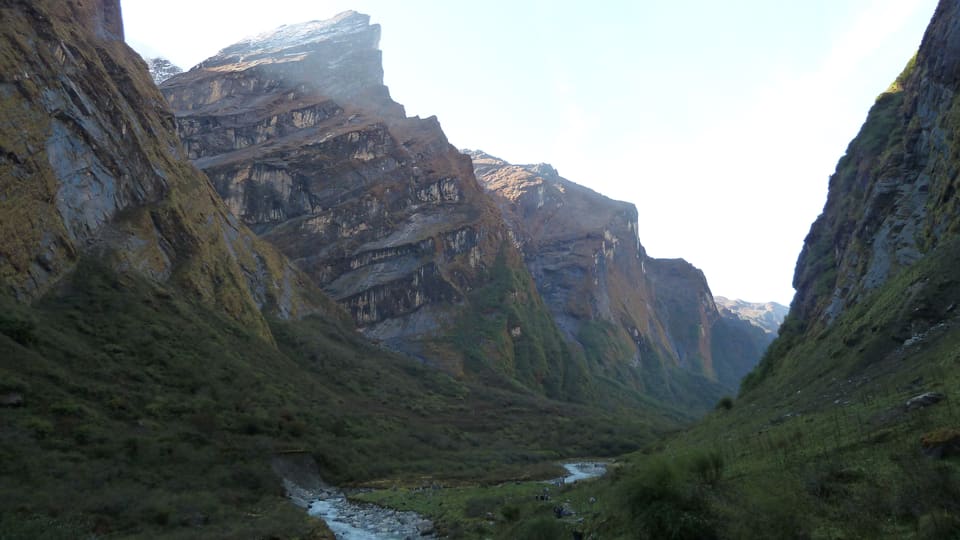
The shape of the daily bill follows the trail's own geography. In the opening valleys — the green, road-served stretch through the low villages — the teahouses are the cheapest of the route and the food is close to town pricing. Prices step up through the middle country around Manang, where the acclimatisation days are spent and the altitude tax begins; the high country from Manang over the Thorong La to Muktinath is the expensive stretch of the whole walk, with the carried-in menus and the charged-for comforts at their peak; and the descent into the Kali Gandaki brings the bills back down toward road-economy levels. Budget accordingly rather than averaging: a flat per-day figure overstates the low valleys and understates the pass country.
One budget trap is worth naming: the snack economy. The higher the trail climbs, the more the small purchases — chocolate, canned drinks, the bottled water that replaces the tap — carry altitude pricing, and a week of them becomes a real line. The standard economies are the standard ones for good reasons: a filter bottle or purification drops the water bill to nothing, carrying a few snacks from Pokhara's supermarkets covers the sweet tooth at valley prices, and drinking the teahouse's tea instead of the imported can is both cheaper and the thing the dining room is actually for.
Getting there and back
The Circuit's trailheads sit within a day of both Kathmandu and Pokhara, and the transport budget has three layers. The first is reaching Nepal's lake city: the tourist sofa bus from Kathmandu to Pokhara costs NPR 1,500-1,700 at the 2026 booking platforms, a scheduled eight-to-nine hours that roadworks stretch; the 25-minute flight runs from about US$89 one-way on the booking sites. The second layer is the trailhead run: jeeps and local buses connect Pokhara and Kathmandu to the start-of-walk towns on the Circuit's opening valleys, negotiated locally and priced per seat or per vehicle depending on how you travel — quote them in Pokhara rather than pre-paying in Kathmandu. The third layer is the trek's own shortcut economy: the road that parallels much of the route means any day of the walk can become a jeep day, either as planned transfers that shorten the trek or as an escape hatch for a bad knee or a fast acclimatiser. Those jeeps are negotiated on the spot; no tariff table covers them.
One structural note saves money here: the Circuit does not repeat itself. You finish on the other side of the range from where you started, so the return journey — usually back through Pokhara or down to Pokhara from the Kali Gandaki side — is a second transport line item, not a retraced one.
The jeep question deserves its own honesty, because it is where the Circuit's economics have genuinely changed in the last decade. The roads that follow the old walking route are not an abstraction in the budget — they are a choice every trekker makes several times. Taken deliberately, jeep transfers convert walking days into travel hours and cut both the daily teahouse bills and the guide days by the same amount; taken casually, they erode the walk that the permits and the guide are paying for. The cost pattern to expect: jeep seats on the common sections are negotiated per head and cheap relative to a private vehicle, which is priced per jeep and worth it only for a group. A workable budgeting approach is to decide the itinerary shape first — full walk, partial walk with fixed transfers, or the short version — and then hold that shape in front of you in the negotiations, because the alternative is deciding each morning and discovering that the totals only make sense in retrospect.
Insurance and the mountain margins
Travel insurance with high-altitude trekking and helicopter rescue coverage is the standard requirement agencies ask for before issuing trek paperwork, and the Thorong La — the Circuit's 5,416-metre pass — is exactly the scenario the coverage exists for. Policy prices vary by age, nationality and trip length and are not quoted here; what belongs in the budget is the awareness that a policy covering high-altitude rescue costs more than basic travel cover, and that buying the cheaper policy for a trek that needs the expensive one is a false saving. The other margin to budget is time: a buffer day on either end absorbs the domestic flight delay or the extra acclimatisation day in Manang that the altitude can ask for, and buffer days cost their daily rate like any other day.
Assembled totals, with their assumptions
Put the pieces together and the shapes are these — and the label matters: these are planning estimates assembled from the verified tariffs and quoted market rates above, not figures gathered from Circuit-specific operator surveys. A twelve-day Circuit with a hired guide, teahouse rooms and food at the estimates above, road transport both directions and no flights: roughly US$650-900 per person, of which the guide is the largest line. Adding the Pokhara flight pair adds about US$180-250 at the quoted fares. Stretching the walk to three weeks, or taking more jeep transfers, moves the total in the obvious directions.
For the package shape — the agency arranging guide, permits, transport and sometimes accommodation in one price — no Annapurna-specific package range was gathered for this guide, and none is invented here; the honest approach is to compare two or three agency quotes line by line against the tariff and market figures above, because package inclusions vary more than package prices do. For scale, the Everest Base Camp trek, quoted at US$900-1,225 independent in its own guide on this site, is more expensive than the Circuit at every line — most of all the flight, which the Circuit does not need at all.
Where the money is worth spending
The Circuit's budget has exactly two levers worth understanding. The first is the guide — mandatory now, variable in price between operators, and worth choosing well rather than cheaply: the difference between US$25 and US$35 a day is smaller than the difference between a guide who manages altitude decisions well and one who does not. The second is pace: every extra day on the trail is a modest daily bill, but rushing the acclimatisation is the one economy this trek punishes hardest, and the acclimatisation day in Manang is not the place to save. Everything else — the jeeps, the flights, the rooms — is arithmetic. The permits guide on this site has the paperwork in full, and the month-by-month guide explains why the October and April windows book out first.
Sources: Nepal Tourism Board — park entry fees and TIMS card pages (ntb.gov.np, fetched 1 November 2026). Guide rates, teahouse room ranges, bus and flight fares from 2026 operator quotes and booking platforms (nepalvehiclerental.com, bussewa.com.np, 12go.asia, trip.com), retrieved 1 November 2026. Daily trail-food figures are planning estimates extrapolated from 2026 Everest-region operator quotes, as flagged in the text; assembled totals are derived from these inputs and are labelled as estimates.
From readers
Traveller experiences
Personal notes and ratings from readers who have been to Annapurna Circuit.
Checking your session…
No experiences yet.
Sign in to be the first reader to describe this place.
Keep reading
More stories from this collection are coming.