
Cappadocia and Central Anatolia: A Practical Guide from Göreme
Rock churches around Göreme, Uçhisar Castle, walking the Rose Valley, Avanos pottery, the underground levels at Kaymakli and balloon flights, with real timings, costs and route advice.

Cappadocia is a region, not a single town, and it spreads across parts of Nevşehir, Aksaray, Kayseri and Niğde. The best-known scenery sits around Göreme, where eruptions from Erciyes Dağı, Hasan Dağı and Göllü Dağ left layers of soft volcanic tuff. Settlers cut into that rock to make houses, churches, storerooms, wineries and whole underground settlements. The UNESCO property is officially called Göreme National Park and Rock Sites of Cappadocia, and it has been a World Heritage Site since 2012.
This guide centres on Göreme, whose town centre is at 38.6431, 34.8289. Three days covers the main sights, but four days lets you walk the valleys properly instead of ticking off the viewpoints and moving on. The region works best between April and June and from September to October. Balloon flights depend on wind, so even a well-planned trip needs one morning you can move around.
Göreme and the rock-cut churches
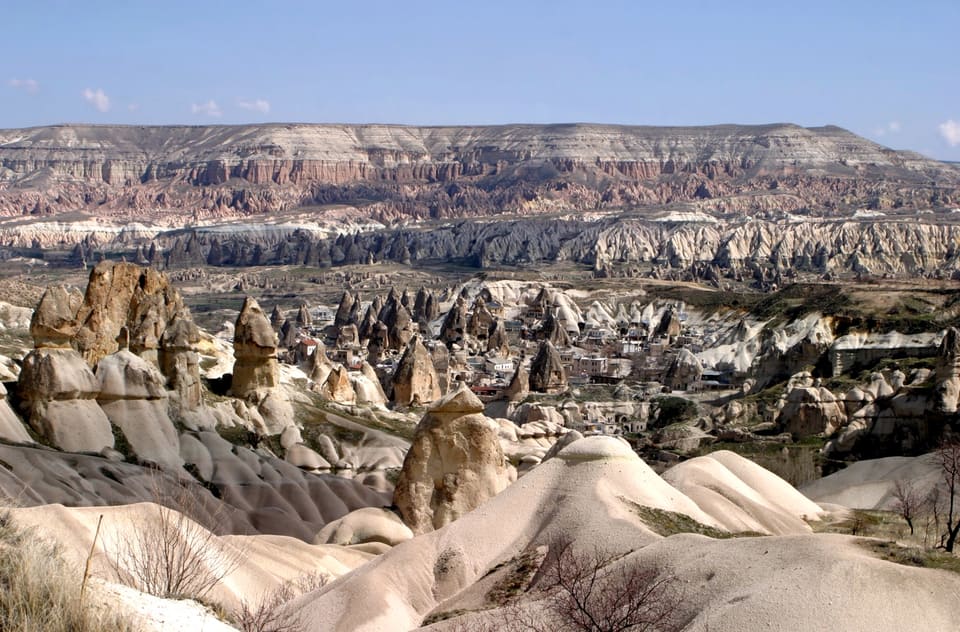
Göreme sits at about 1,100 metres above sea level, and the valleys around it get much colder at night than the daytime heat suggests. The town is the sensible base, since most cave hotels, restaurants, tour offices and excursion pickups are here. The Open-Air Museum and Göreme National Park have separate admissions, even though the museum lies inside the protected landscape. Buy both if you plan to visit each.
The museum contains churches cut into the slopes of Rose Valley. The Dark Church, or Karanlık Kilise, has eleventh-century frescoes of bishops, military saints and mounted figures, framed by blue, red and green geometric bands. The Apple Church, Elmalı Kilise, has a larger collection from the thirteenth century, including Christ teaching, apostles, a tree of life and scenes from the Last Judgment. St Barbara, St Basil and several smaller chapels are open too, though access changes while sections are conserved.
Set aside at least two hours for the museum. Light is kept low in the painted churches because strong light and flash can damage pigments, and some rooms are roped off or closed with little warning. A slow circuit past the rock cells, kitchens, stables and wine presses says more about how the complex worked than a quick look at a handful of frescoes. Each church has its own photography rules, so read the signs before you use a camera.
Uçhisar Castle and the view down the valley
Uçhisar is about five kilometres from Göreme. Its natural rock citadel rises roughly 60 metres above the town around it and reaches about 1,350 metres above sea level. A steep carved stairway leads to a small platform at the top, with views over Göreme, the Rose and Red valleys and the patchwork of fields beyond. On a clear morning, when there is no low haze, Erciyes Dağı comes into view.
The climb takes 15 to 20 minutes and admission is separate. Early morning is the least crowded time; coach groups and photographers tend to arrive well before sunset. In summer, parking near the castle can already be difficult by 17:00. If you want the view without the traffic, walk the 4 kilometres from Göreme or get there before 08:00. Stay 30 to 45 minutes rather than assuming the first viewpoint has everything.
Çavuşin, Avanos, pottery and old kilns
Çavuşin lies on the road between Göreme and Avanos. Its Church of St Nicholas was cut into a cone-shaped hill in the eleventh century. The barrel-vaulted roof, carved cross designs and damaged wall paintings are still visible, although the frescoes are less complete than those in the Open-Air Museum. The village also has old houses, pigeon towers and a cinema carved into the rock. Allow 45 to 60 minutes for the church and a walk through the lanes.
Avanos, 10 kilometres north of Göreme, is where the pottery trade centres. Potters work red clay from the Kızılırmak area, throw pots on a wheel, add mineral colours and fire them in gas or electric kilns. Historic workshops and old kiln sites around Avanos and Çavuşin show how local clay has been fired for centuries, though the medieval furnaces no longer burn continuously. Several workshop visits come with a sales pitch. Before ordering a large pot, ask for the retail price, what worldwide shipping costs and what the return policy is.
Balloon flights: early, late and the crowded middle
Most passengers get picked up at their hotel between 04:00 and 05:30, depending on the season and the assigned launch slot. Flights normally last 60 to 90 minutes, with a drive back for breakfast afterwards. Launches usually run from around 05:30 to 07:30. In summer the early basket leaves before sunrise, while in spring and autumn it may already be daylight at launch.
The first flight usually gets cooler, steadier air and fewer people at the launch field. Mist is possible, so the first light may be less clear than photos suggest. Later flights get higher sun and stronger colour, but the air can turn windy at altitude as the day warms. The middle slot is the busiest, with more vans, passengers and recovery crews sharing the launch area. The flight slot itself offers no better view than the earlier or later baskets.
Expect to pay around 4,000 to 6,000 TL per passenger for a standard shared flight at recent prices, with longer flights and private baskets costing more. A quote should spell out the flight duration, basket capacity, hotel transfer and insurance. Cancellations for weather are normal and don't mean the operator is unreliable. In high season, book a flight early and keep another morning free in case the first is scrubbed.
“Keep one morning free after the balloon morning. The wind changes the plan, and you need somewhere to go when it does.” Elif Demir, a Göreme-based walking guide
Rose Valley and the walk most visitors skip
Contrary to what you might hear, people do hike Rose Valley, and several routes near Göreme and the Sunset Point are busy. What most visitors skip is the walk along the valley floor, through Yılkı Valley and on towards the hermitages, old churches and Çavuşin. A quick stop at a sunset terrace is not the same as walking through the valley, and the gap between them is about two hours of exposed, uneven ground.
A common loop from the Sunset Point area is roughly 4 to 6 kilometres and takes about two hours, though GPS distances differ according to the route. The longer Göreme-to-Çavuşin walk through Rose and Red Valley is closer to 9 to 10 kilometres and takes four to five hours. Start around 07:00 or after 15:00. Sunset varies from roughly 18:15 to 20:00 across the season, so a published sunset time without a date is unreliable. Carry at least 1.5 litres of water because there is little shade or drinkable water along the route.
Kaymakli and the engineering underground
Kaymakli is about 12 kilometres southeast of Göreme. The underground city there has around eight levels, reaches roughly 45 to 60 metres below the surface and contains dozens of rooms. A standard visit takes 60 to 90 minutes, usually with a guide. Low doors, narrow passages and steep stairs make it unsuitable for anyone uncomfortable in confined spaces. Underground temperatures are often 10 to 15 degrees, so a light layer helps even in summer.
Some 50 ventilation shafts served the settlement. The best known is a well roughly 1.5 metres across that drops as far as 85 metres. Cool air came in through lower openings and connecting passages, while warmer air escaped up vertical shafts, producing a basic stack effect. That helped control heat, dust and humidity. The sites were more than bombproof shelters, holding storage rooms, workshops, animal areas, kitchens and hiding places used during raids. Derinkuyu, 9 kilometres away, has around 18 levels and goes deeper, to roughly 60 metres.
The monastic complex and Pigeon Valley
The rock-cut monastic complex around the Open-Air Museum is bigger than the church section most visitors remember. Monks lived in cells stacked up the slopes, some fitted with cupboards, sleeping platforms and small storage rooms. Kitchens, ovens, presses and covered corridors were shared. Many cells opened through narrow gaps that limited the view, which helped with heat and privacy. Walking through these domestic spaces takes longer than the painted churches and gives a clearer sense of monastic life.
Pigeon Valley lies north of Uçhisar, where hundreds of small square pigeon houses are cut into the cliff. Collectors once took out the droppings and used them as fertiliser, particularly on vines. A marked path from Uçhisar drops into the valley and then climbs steeply across to Göreme, covering about 4 to 5 kilometres in two to three hours. Stay on the established trail rather than scrambling over ledges, and don't climb into the pigeon houses. The rock is loose in places and there is little shade along the way.
Planning three days, or four for the valleys
Three days covers the main route. On day one, see the Open-Air Museum in the morning, walk part of Pigeon Valley and reach Uçhisar before the afternoon coaches arrive. Day two belongs to the balloon flight, with a walk in Rose Valley later on or a visit to Çavuşin if the flight is cancelled. On day three, combine Kaymakli with Avanos and its pottery workshops. A car makes that day much easier, though the schedule is full and slightly compressed.
A fourth day makes better sense for valleys than for adding more towns. Add the full Rose and Red Valley route, the Yılkı hermitages, a second underground city or a more relaxed walk around Uçhisar. Four days also give the balloon a proper spare morning. With only three days, keep that morning flexible and don't book a non-refundable sunset tour straight after the flight.
April to June and September to October are the most comfortable months. May and late September give the easiest walking, while April can still be cold at dawn. In July and August the afternoon temperature regularly reaches 30 to 35 degrees, with a few hotter days. Winter brings snow, freezing nights and reduced access to some cave sites. Balloons fly frequently in summer, but the heat and crowds are part of that trade-off.
Tickets, heat and what to carry
Tickets for Göreme National Park and the Open-Air Museum are sold separately. At recent published rates, adult admission has been around 300 TL each, so allow roughly 600 TL for the two and check for changes. Uçhisar Castle has recently charged around 100 to 200 TL, and Kaymakli around 250 to 400 TL. Turkish admission prices change often, so confirm the current figures on the official museum site and carry some cash for smaller ticket offices.
For a half-day walk, take a hat, high-factor sunscreen, sunglasses, sturdy shoes and 1.5 to 2 litres of water. Valley paths carry loose stones and sharp rock, and shaded stretches are few. A light jacket is worth carrying even in summer, since the temperature at 1,100 metres can fall sharply after sunset. Download offline maps before you go, because phone reception disappears in several valleys, and photograph the trail map at your hotel before setting out.
Flights, car hire and getting around
Kayseri Erkilet Airport and Nevşehir Kapadokya Airport are the main gateways. Kayseri is roughly 50 kilometres from Göreme, Nevşehir about 30. The drive often takes 30 to 50 minutes, but allow about an hour from each airport to reach a hotel, including the transfer and waiting for bags. A shared transfer usually costs around 100 to 200 TL per person, while a private car is roughly 2,000 to 3,500 TL. From central Nevşehir, the bus to Göreme takes around 45 to 60 minutes.
You can manage central Göreme without a car, but having one helps with Avanos, Kaymakli and the trailheads. A small car with broad insurance is commonly about 40 to 70 euros a day, rising in July and August or for larger vehicles. Türkiye generally accepts valid foreign driving licences for short visitor stays, but rental firms set their own rules. Carry your passport, your original licence and an International Driving Permit if your country issues one. Photograph the bodywork and tyres before setting off, and don't expect a rental car to be much use on a balloon morning.
Rock hotels, cave restaurants and ordinary meals
Rock hotels are concentrated most heavily in Göreme. Taskonak and Argos sit at the expensive end, often around 250 to 450 euros a night, while places such as Rose Pension and Cave Hotel cost roughly 60 to 120 euros. Mid-range hotels sit between 120 and 220 euros. Prices can change sharply by season, and some rates exclude breakfast. Cave rooms can be cool and attractive, but expect steep stone steps, no lift, weak sound insulation and the occasional damp patch. If you have luggage, ask for a room near the entrance.
Eat in the town rather than paying just for a valley view. Topdeck Cave Restaurant has a rock dining room and a busy terrace, while Dibek is a practical stop for Turkish dishes. At a local lokanta, try pide, mantı, lahmacun or ocakbaşı. Recent central Göreme prices are roughly 200 to 400 TL for breakfast and 300 to 700 TL for dinner before drinks. Lunch usually costs less in Avanos. If a menu is priced in euros or dollars, ask for the lira price and what each charge includes.
The warning worth reading: keep a spare morning
Don't build a non-refundable day around a balloon flight. An operator can cancel during the night or shortly before launch if wind at altitude makes the flight unsafe, even when the ground in Göreme looks calm. Keep the following morning free, read the refund terms before paying, and ask whether a weather cancellation is credited automatically. If the first flight is called off, the spare morning can go on the Open-Air Museum, a pottery workshop or a shorter walk.


Cappadocia and Central Anatolia, Türkiye
Steer clear of unlicensed quad tours sold by street touts; the accident and insurance records are often poor. Don't touch frescoes, enter roped-off cells or climb into pigeon houses. Keep valuables out of an unattended rental car, and don't leave luggage visible at a café. For sunset at Uçhisar, walk or arrive early instead of joining the traffic jam. A local guide is more useful than a shop commission, particularly on a full-day valley walk.
Eastern border crossings are not a Cappadocia side trip
Cappadocia doesn't have a border crossing of its own. Doğubayazıt sits roughly 570 kilometres east of Göreme, usually an 8.5 to 10 hour drive. Gürbulak, the Iran crossing, is another 55 to 60 kilometres beyond Doğubayazıt. Kapıköle, the other main crossing into Iran, is about 850 to 900 kilometres from Göreme and takes 12 to 14 hours. Habur, south of Doğubayazıt, is the crossing with Syria. These are long transfer days, not reasonable excursions from a balloon base.
Crossings are usually advertised as open around the clock, but closures, document checks and regional conditions can change at short notice. Check the position with the Turkish Ministry of Interior, your embassy and the border authority before you travel. Carry your passport, valid visa or residence documents, travel insurance, vehicle registration and insurance papers, and an onward ticket. Ask for an official entry stamp when there is no electronic record. If your onward transport is uncertain, fly to Erzurum or Van rather than spending a day in cars and border queues.
From readers
Traveller experiences
Personal notes and ratings from readers who have been to Cappadocia and Central Anatolia.
Checking your session…
No experiences yet.
Sign in to be the first reader to describe this place.
Keep reading
More stories from this collection are coming.