
Chiang Mai and the Northern Hills: A Practical Guide
The old walled city, the hill tribes to the north, and elephant camps that are either reformed or not. A six-day guide with real costs and timings, plus a firm warning about the smoke season.

Chiang Mai works well as a base, but it takes a while to read at street level. The historic core is roughly square and easy to walk, while the roads worth remembering head north into the mountains. A sensible trip gives four days to the city and two more to the hills. That is enough for the old temples, Doi Suthep, a cooking class, one properly chosen elephant visit, a walk through a hill village and a full day around Doi Inthanon. It also leaves room to slow down when the heat, the traffic or the temple fees begin to wear on you.
The old city, its moat and roughly 300 temples
The old city was laid out in 1296 by King Mengrai, a square about 1.5 km on each side. Much of the defensive moat survives, around 60 metres wide in many sections, now a band of grass, trees and walking paths. The walls have fared worse, but the moat still marks the old quarter clearly. Step across it and the main grid begins, with temples, guesthouses, coffee shops, restaurants and market stalls packed into a small area. The centre is noisy, especially around the night market and the weekend walking street, but it remains practical on foot.
There are roughly 300 temples inside the old city or close to it. Lanna architecture gives them a character unlike anything else in Thailand. They do not imitate Bangkok's grand prangs or Ayutthaya's brick towers. Instead you get steep, layered roofs, sharply carved wooden gables, naga stairways, guardian lions, square stepped bases and tall gilded chedis. Painted murals often cover the inner walls, while teak buildings use heavy posts, raised floors and broad overhanging eaves designed for ventilation and heavy rain.
Wat Chedi Luang is the largest and most imposing ruin in the centre, with a massive square base that once supported a taller chedi. Wat Phra Singh is quieter, its revered Lanna-style chedi carrying finely painted details. Wat Chiang Man has heavy teak construction and a distinctive square chedi on a stepped base, while Wat Umong, partly sunk into the ground, offers a quieter break from the busiest streets. A day of temple hopping without a plan turns repetitive, so pick three major sites and add Wat Umong or another small monastery rather than trying to count all 300.
Most temples charge foreign adults 30 to 100 baht. Carry small notes, because many entrances have no card terminal and no change. Shoulders and knees should be covered. Women are usually given a long sarong at the entrance, and men may be asked to cover their legs, but bringing a scarf saves time and makes the visit less conspicuous. Shoes come off again and again, so easy-to-slip-on sandals beat heavy trainers. Go near opening time, return between 3 pm and 5 pm, and keep the middle of the day for lunch, museums or a break from the heat.
Nok Srisai, an elephant-care adviser in Mae Sa, puts it plainly: if the elephant cannot walk away without permission, it is not choosing the interaction.
Wat Phra That Doi Suthep and its 306 steps
Doi Suthep rises about 1,076 metres above the city, 15 km from the old centre. Most people reach the temple by road, park near the naga bridge and climb the famous 306 steps to the golden chedi. The staircase is steep and there is little shade, although the lower flights give you views over the city. Foreign adults currently pay about 30 baht. A red songthaew from the old city usually costs 30 to 40 baht and takes 20 to 30 minutes up the hill, depending on traffic. A Grab or taxi is quicker and costs roughly 150 to 250 baht each way.
The formal reward at the top is a view across the Ping River valley. On a clear morning the city, patchwork fields and distant ridges show up in sections, but cloud, humidity or smoke can close the view completely. Do not plan the visit around a perfect panorama. The chedi courtyard, naga balustrade and forest around the summit are worth seeing even when visibility is poor. This is an active temple, so behave accordingly: no climbing on sacred structures, no drone flights and no posed group photographs in the main prayer area. Weekends after 10 am can be crowded enough to make the steps frustrating.
Doi Inthanon, Thailand's highest peak
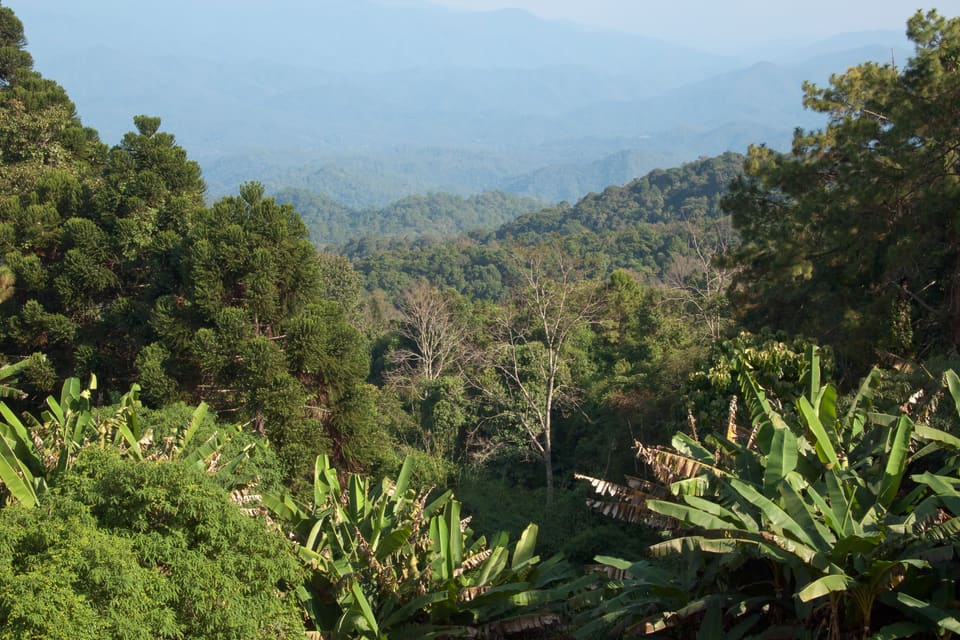
Doi Inthanon reaches 2,565 metres, the highest peak in Thailand. It lies about 90 km northwest of Chiang Mai, but the drive takes closer to one hour and 45 minutes to two hours because of the bends. The road climbs through forest, farms and villages before the final steep section below the summit. At the time of writing, a foreign adult pays about 300 baht for national park entry and 30 baht per vehicle. Thai adults and children pay lower rates. Save the receipt, since it is checked again at the pagodas and on some trails. Online articles often quote old rates, so check the posted price rather than budgeting from a blog written several years ago.
At the top are the twin royal pagodas, the King Pagoda and Queen Pagoda. They were built in the 1950s in honour of King Rama VI and Queen Rambhai Barni. The white, orange and gold structures stand side by side and can be visited in about 30 minutes. For many hikers the surrounding forest matters more than the architecture. The Ang Ka Nature Trail is a 3.5 km loop through mature forest, with a chance of monkeys and hornbills and a viewpoint over the valley. Allow two to three hours. Paths can be slick and the higher sections are cold, particularly before sunrise.
Other stops include Kew Fin waterfall and the seven-level Wachirathan waterfall. Both have steps, railings and controlled swimming areas, but the upper Wachirathan cascade is closed during heavy rain. On a clear December or January morning the summit can fall to 5 to 10°C, and colder wind makes a fleece necessary even while the city remains warm. Bring water and a packed lunch, because food choices above the main visitor area are limited and overpriced. Do not swim in the streams. The park is busy from 8 am to noon on weekends and public holidays, so an early start gives noticeably better conditions.
How to screen an elephant camp in thirty seconds
A thirty-second screen can eliminate most riding camps. Look for signs that the venue offers rides, tricks, performances, log handling, baby elephants, staged handshakes or posed bathing. Those are visitor attractions, not observation-based sanctuaries. The best programmes have no riding seats, no performing area, no breeding programme aimed at supplying tourists and no routine separation of calves from mothers. Visitors should watch rather than direct the animals. A venue that keeps elephants in a small concrete pen, or chains several animals together for most of the day, has not solved the welfare problem merely by changing its brochure language.
Ask one question: can the elephant choose to walk away? A good observation programme allows meaningful space, limited visitor numbers and elephants that are not summoned for every scheduled group. Chains are not an automatic verdict, since they may be used temporarily for veterinary treatment or a recently arrived animal, but permanent restraint and sharp control tools visible to tourists are serious warning signs. Natural behaviour is also easy to misread. Ear flapping, trunk movement and swaying can occur without distress, so a brief observation cannot establish whether a place is genuinely ethical.
No single Thai government category guarantees that an operator is a sanctuary. Once the quick screen is done, look at recent dated reviews and photographs, the stated visitor limit, the animal histories and whether direct contact is optional. A no-contact observation day is the cleanest option. Handing over 2,000 or 3,000 baht for twenty minutes of holding food while a handler directs the elephant buys an expensive photograph, not a conservation experience. Skip anywhere that puts the animal's behaviour on the ticket, including elephant shows, miniature elephant displays and places selling guaranteed selfies.
Hill tribe villages and respectful visits
The mountains north and west of Chiang Mai contain Karen, Hmong, Lahu, Akha, Lisu and many other communities. Hill tribe is a loose administrative label, not one culture. Villages differ in language, religion, food, dress, history and attitudes toward tourism. Karen settlements are found around Doi Inthanon and Mae Sa, while Hmong communities are scattered around Mae Sa, Doi Pui and Mae Salong. Some villages operate homestays, weaving studios, coffee shops and community tours. Others have little interest in tourism and should not be treated as open-air museums.
A respectful visit starts with a community-led guide or a booked homestay, not a coach tour that drops off several buses at once. Ask before photographing people, homes, farms, ceremonies or children. Do not enter a house or compound unless invited, and do not hand out sweets, small gifts or cash. Buy crafts directly, accept the stated price and ask whether an item was made locally. Avoid conversations about citizenship, land rights or politics unless the other person raises them. At Karen villages associated with long-neck jewellery, do not touch the neck rings or ask residents to put them on for a photograph. Many communities have their own views on how tourism should be managed, and those views are more varied than tour companies suggest.
The night bazaar, Sunday walking street and cooking classes
The night bazaar runs along Tha Phae Road and nearby streets from about 5 pm until late evening. Food is the strongest part. Grilled pork, chicken, roti, seafood, mango sticky rice, fruit juices and cold beer usually cost 20 to 80 baht. A Thai massage in the bazaar commonly costs 200 to 400 baht for an hour, though prices and service quality vary. The western sections sell a lot of generic clothing, mass-produced souvenirs and tourist decorations. Compare prices before buying, particularly for silver, gems and anything described as handmade. The market gets hot, crowded and loud after 7 pm, so anyone uncomfortable with dense crowds should arrive early.
The Sunday walking street takes over Rachadamnoen Road and several connecting lanes from roughly 4 pm to midnight. The road is closed to cars and stretches for around 2 km, with stalls selling food, clothes, handicrafts, flowers and household goods. It works better as an evening walk than as a shopping trip, particularly for people who have seen similar markets elsewhere. Parking near the main area becomes impossible after 5 pm. Food often sells out by late evening, so eat before 7 pm or after 9 pm. Keep bags in front of you and agree on a meeting point if you are travelling with children.
A good cooking class should include a guided market visit, a small group of no more than eight people, hands-on preparation, a full meal and recipe notes. Expect to pay 1,000 to 1,800 baht. Classes above 2,000 baht need to justify themselves with more than a short demonstration. Thai Farm Cooking School and Aum Thai Cooking School are the names usually recommended, but check recent reviews, the current group size and whether the quoted price includes transport, lunch and drinks. Tell the school about allergies and vegetarian requirements in advance. Learn northern dishes such as sai ua, nam prik ong, gaeng hung lay and khao soi rather than spending the session making only a familiar pad thai.
Mae Sa Valley, elephants, Karen and Hmong villages
Mae Sa Valley lies roughly 15 to 30 km east of the old city, although travel times range from 30 minutes to more than an hour depending on the destination. The route takes in the seven-level Mae Sa waterfall, forest trekking, bird-watching sites, zip lines, coffee stops, elephant programmes and Karen and Hmong villages. It is a collection of separate sites rather than one compact attraction. Walking between them takes longer than the brochures imply, and a day spent trying to complete every activity can become a day of transfers. Pick two or three interests and leave the rest alone. The waterfall currently charges foreign adults about 100 baht, Thai adults about 50 baht, plus a 20 baht ticket and a 30 baht vehicle charge.
Elephant Nature Park in the wider Mae Sa area runs observation-focused visitor programmes rather than rides. Half-day and full-day visits are roughly 1,500 to 3,500 baht depending on the programme and booking date, so confirm the current price directly. Elsewhere in the valley, the large Mae Sa Elephant Camp operates as a visitor attraction with its own conservation and welfare claims. Do not assume that the word camp proves the same standard as a no-contact sanctuary. Read the current activity list, decline any ride, performance or directed feeding session, and look for recent independent reviews. In the surrounding villages, use a local guide, pay homestays and workshop fees directly, and avoid turning family compounds into photo sets.
When to go, and when to choose a different season
The best time to go is November to February. The air is usually clearer, cool-season nights make walking easier, and heavy rain is less likely to affect the mountain roads. January is comfortable but busy, with more domestic tourists and higher hotel rates. Late November through December gives you good conditions with fewer peak-season crowds. In Chiang Mai, daytime temperatures often reach 25 to 30°C, while the mountains can be 10 to 15°C colder. From November onward, a light jacket belongs in the day bag. May to October is wetter, with flash floods and landslides affecting mountain roads, but it also brings fewer visitors and lower prices.
Steer clear of the first half of March too, since smoke can arrive before local crop burning reaches its worst. The severe period normally runs through April, but the exact dates depend on weather, local burning and smoke drifting in from neighbouring countries. A clear view on arrival is no guarantee that the next week will be safe. Check Air4Thai before booking, then again each morning. If your dates are fixed, a properly fitted N95 respirator, a room with a HEPA filter, indoor exercise and lower-intensity plans reduce particle exposure. That does not make severe smoke safe, and many temples, trails and roads can close without much notice.
How long to allow and how to sequence the trip
Set aside four days for the city and two more for the hills. Day one is the old city on foot, from Wat Chedi Luang to Wat Phra Singh, Wat Chiang Man and the moat. On day two, get to Doi Suthep early, rest through the afternoon and eat at the night bazaar or the Sunday walking street. Make day three a cooking class, with a temple or museum in the cooler late afternoon. Give day four to Mae Sa Valley, including an observation-based elephant programme or a community-led village visit. Leave one evening free; the night market and the traffic can wear you out.
Use the fifth day for the full Doi Inthanon loop: Kew Fin, Ang Ka, the twin pagodas and the summit viewpoints. Leaving early matters more than adding another stop. A second day in the hills could take in a quieter stretch of the park, a nearby community-led village or Doi Ang Khang, where the road is calmer and Karen villages and coffee tourism are the main attractions. Two nights up there give you more breathing room than a rushed day trip, though a homestay should be booked through the community or a reputable operator rather than an anonymous internet listing.
Getting to Chiang Mai and moving around
The flight from Bangkok takes about an hour. Most regional services use Don Mueang Airport, and including the short taxi or bus transfer to the old city, the trip usually comes to 1 hour 5 minutes. A Chiang Mai airport taxi to the moat costs around 150 to 220 baht. A red songthaew is roughly 30 to 50 baht per person and follows the airport's fixed route. The overnight bus from Mo Chit takes roughly 10 to 12 hours and costs about 650 to 1,200 baht depending on the seat. The train runs about 12 to 14 hours and can cost 600 to 1,000 baht.
Inside the old city, walking is usually faster than riding a scooter through traffic. Red songthaews can be hailed at the side of the road, and short trips commonly cost 20 to 40 baht per person. Rentals run around 250 to 350 baht per day or 800 to 1,200 baht per week, but you need a helmet, a valid licence and real experience of Thai traffic. Out on the mountain roads there are blind bends, gravel, motorbikes carrying passengers and slow trucks. For Doi Suthep, take a songthaew or taxi. For Doi Inthanon, join a minivan excursion for about 500 to 900 baht, or charter a vehicle for roughly 1,000 to 1,500 baht per day, depending on how many passengers you are and whether a driver is included.
What things cost
Set aside 30 to 100 baht for temple entry. National park charges work out per vehicle, with separate per-person rates also applied at northern parks. Doi Inthanon costs about 300 baht for each foreign adult plus 30 baht per vehicle, while Mae Sa adds a vehicle charge on top of adult admission. A standard cooking class is 1,000 to 1,800 baht, and observation-based elephant programmes in Mae Sa usually run 1,500 to 3,500 baht. A songthaew across town costs 20 to 40 baht, while a day charter in the hills is 1,000 to 1,500 baht. Carry a mix of small notes and keep emergency cash separate from the day's spending.
Breakfast at a simple place costs 30 to 60 baht, a meal at a local restaurant 60 to 150 baht, and most market dishes 20 to 80 baht. Coffee is generally 40 to 90 baht. A modest day in the city can be done for 1,500 to 2,500 baht excluding lodging, while a Doi Inthanon day with transport, entry, food and incidentals comes closer to 2,500 to 4,000 baht. An old-city guesthouse generally costs 900 to 2,500 baht per room, while restored teak houses and higher-end hotels run from 3,000 to 7,000 baht. If a traditional teak room matters to you, book early for the November to February peak.
Where to stay inside the moat
Stay inside the moat in a traditional teak house, ideally within a short walk of Wat Chedi Luang or Wat Phra Singh. That puts food, temples, the night bazaar and the Sunday market within reach, with no daily transport needed. A genuine heritage teak building may come with creaking floors, thick walls, shared bathrooms, steep stairs and little soundproofing. Ask whether there is air-conditioning or only a fan, request a room away from the street and check the hot-water arrangement before paying. A simple room in a converted teak house usually costs 900 to 2,500 baht, while a polished heritage stay can cost several times more for atmosphere rather than extra space.
Where to eat in the old city
For khao soi, try Khao Soi Khun Yai near Wat Lok Moli, where a bowl usually costs about 50 to 70 baht, or Khao Soi Lam close by for 40 to 60 baht. Kanjana does more refined northern Thai cooking at roughly 150 to 300 baht per dish, and Huen Muan Jai in Nimman serves hearty Lanna food for about 100 to 250 baht. The night bazaar is cheaper and quicker, with grilled skewers, sai ua, roti, curries and sticky rice generally between 20 and 80 baht. For a proper northern meal, order nam prik ong with vegetables, sai ua or gaeng hung lay. For vegetarian food, say jay and confirm that fish sauce and other animal products have not been added.
What to avoid
Skip elephant rides, elephant shows, tiger selfies, captive cub encounters and any venue offering a fixed series of tricks for a photograph. Chiang Rai day trips sold as visits to tiger temples or tiger kingdoms are not responsible wildlife experiences, whatever the name on the ticket. Be wary of jewellery and gem shops that create urgency, of unmarked motorbike rental stalls and of off-road jeep trips that pressure visitors onto prohibited paths. Carry your passport, since police checkpoints are common, but never hand it to a tout. Avoid wildlife products, ivory, tiger bones and medicine promoted as a cure.


Chiang Mai and the Northern Hills, Thailand
The warning worth reading: never travel in mid-March to April
The smoke is not scenery. For several weeks it can raise PM2.5 past levels at which outdoor activity is safe for most people.
Never book the main trip between mid-March and the end of April. The burning season in March and April makes the air genuinely dangerous. Fine crop particles can travel hundreds of kilometres, so a green hillside or a clear morning does not guarantee safe conditions. During severe episodes, PM2.5 in the region can exceed 150 micrograms per cubic metre and sometimes 250, against a 24-hour guideline of 15 for healthy adults. People with asthma, heart or lung conditions, older travellers and young children face the greatest risk.
Check Air4Thai before you go and every day while you are there. Above a PM2.5 reading of 50, sensitive groups should reduce prolonged outdoor exertion; above 150, everyone should avoid strenuous activity outside and stay in filtered indoor spaces where possible. A close-fitting N95 helps with particles, but it does not make heavy exposure harmless, and a cotton mask is no help at all. Mountain trails can close, visibility on Doi Suthep can vanish and road journeys get harder. The responsible answer is to move the trip to November, December, January or the first half of February. If those dates will not work, build in cancellations, monitor conditions daily and be ready to abandon outdoor plans rather than treating smoke as a minor inconvenience.
From readers
Traveller experiences
Personal notes and ratings from readers who have been to Chiang Mai and the Northern Hills.
Checking your session…
No experiences yet.
Sign in to be the first reader to describe this place.
Keep reading
More stories from this collection are coming.