
Chitwan National Park: A Practical Guide to Rhinos, Gharials and Real Safari Costs
Probably the best place anywhere to see a one-horned rhino, one of the worst to count on a tiger, and the conservation argument that runs underneath both.

Sauraha is where most people base themselves for Chitwan National Park, and the main visitor gate sits beside the Rapti River. The Sauraha reference point is 27.5291, 84.3542. The park itself covers 952.63 square kilometres, with a buffer zone of roughly 1,950 square kilometres around it. It became Nepal's first national park in 1954 and a UNESCO World Heritage Site in 1984. Most visitors arrive from the Chitwan side in Bagmati Province, though the protected landscape carries on west into Nawalparasi. The UNESCO listing protects the park's habitats and species. It does not guarantee you a particular animal, a quiet vehicle or a good lodge.
Chitwan earns its two days even if the closest large cat you see is a distant shape in a tree. Give it three if you want a registered guide to lead a walking programme through the buffer zone. The appeal rests on a manageable list of animals: hundreds of greater one-horned rhinos, a recovering gharial population, big herds of gaur, common sambar and barking deer, and Nepal's most reliable chance of a leopard without anyone trying to sell you a guaranteed tiger.
The rhino population and what counts as a good sighting
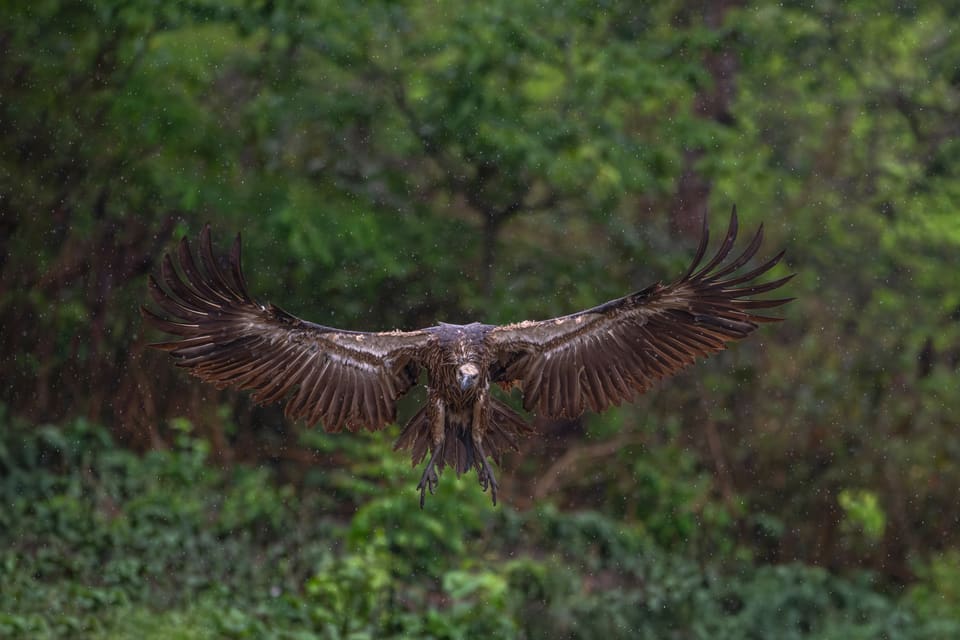
The plain answer is roughly 500 rhinos in Chitwan and about 650 in Nepal, not 650 inside the park. The Department of National Parks and Wildlife Conservation counted 650 greater one-horned rhinos across the country in its 2021 census. Around 504 of those were recorded in Chitwan, more than three quarters of the national population, with the next largest group in Parsa. Planned translocations from Chitwan to Parsa have changed the local distribution since then, so treat the census figure as a reference point rather than a live counter at the gate.
The population climbed back from roughly 50 animals at its mid-20th-century low. Protection, anti-poaching patrols, controlled grassland management and better protection outside the core park all played a part. The Patara Rhino Breeding Centre, set up in 1982, has bred rhinos and supplied animals for conservation programmes elsewhere. The floodplain gives a rhino what it needs too: deep grass to feed in, shade in the sal forest, wallowing sites and dependable water.
A good sighting doesn't have to mean a close-up photograph. It means a clear identification, enough time to watch the animal feed or move, and a guide who can tell you the distance and direction without shouting. A mother with a calf is a better thing to watch than a disturbed animal standing by the road. Fifteen or twenty quiet minutes from an open jeep counts. A brown shape in the grass that turns out to be a deer does not, even if the guide insists it is a rhino for several minutes.
Your best chance comes in open grassland, often in the first hour after sunrise or in the late afternoon. The main concentration around Sauraha is good without being automatic. A day can give you tracks, fresh dung and warning calls and still no animal. Don't pay for a baited encounter, a rhino held at a tourist site or a guide who drives straight at an animal. Wild rhinos already carry enough pressure from habitat fragmentation and road traffic.
Gharial recovery and winter river pools
Gharials came back from a base of roughly 50 animals. Surveys in the late 1970s and 1980s found numbers around that level, the 2007 count recorded 54, and the 2010 count reached 80. Recent estimates put Nepal's total somewhere near 100 to 120, with well over half of them in Chitwan. Protection from hunting, care for riverbanks and stronger enforcement in community conservation areas all contributed.
Winter is the better season, when the rivers drop and gharials gather in deeper, slower pools. Around the park, records come from the Rapti, Narayani and Lamhi river systems and the side channels connected to them, including parts of the Dudu Khola system. Some of the best seasonal concentrations are in deeper pools and community-managed stretches of the wider river landscape, not right beside Sauraha. Water levels and access change, so ask a local guide which pools hold animals at the moment.
A canoe gives you a better chance of a gharial than a jeep, though nobody can promise one. Look for a long, narrow snout and a low body on a sandbar or half-submerged in a pool. The common marsh crocodile is bulkier and darker, with a broader head. Gharials live mainly on fish and are not aggressive towards people, but they shouldn't be approached. From a canoe, keep to whatever distance the boatman sets.
Gaur, sambar, barking deer and the common leopard
The gaur is the park's most imposing ungulate. A mature bull can stand close to 1.8 metres at the shoulder, and both sexes carry a white stocking on each leg, a pale forehead and a ridge along the back. They move through tall grass and mixed sal forest in family groups, usually four to ten animals. In open grassland, a gaur herd crossing the track is easier to take in than a single rhino lying still.
Sambar are widespread and often turn up in groups of five or more. They are the park's largest deer, with adult males commonly weighing 100 to 150 kilograms and bigger individuals going past that. Look for them along the forest edge, beside wallows and near river crossings around dawn and dusk. Their dark brown coats are hard to pick out against wet grass.
Barking deer, also known as Indian muntjac, are small reddish-brown animals that often go unnoticed until one lets out a sharp, dog-like bark. Adults usually weigh 15 to 20 kilograms. They like dense sal forest, scrub and edges next to grassland, and can be common while staying hard to see. A guide who picks out a muntjac 30 metres away in the trees is giving you more than the animal's reputation suggests.
The large cat that really is common here is the leopard. Chitwan has a healthy leopard population, especially around forest edges, riverine woodland and patches of sal forest. Leopards keep to themselves, so sightings are brief, but expecting one is far more reasonable than expecting a tiger. Watch for a shape on a horizontal branch, a pale underside in a tree, or a leopard crossing the road. A tigress with cubs would be exceptional. Any ordinary operator who promises you a tiger is making a false claim.
Jeep, canoe, walking and night safaris
The jeep safari is the main way to get around the park. A standard outing runs about three to four hours, usually from early morning to late morning, with a second one in the afternoon. The vehicles are open-sided four-wheel-drive jeeps that carry no more than six paying passengers in most packages. Some roads are unpaved and turn rough after rain. The guide may change the route according to tracks, reports and park conditions, which is sensible when it happens before you enter the park rather than after finding a group of tourists.
The canoe safari is a one- to two-hour trip in a flat-bottomed boat, led by a boatman rather than a walking guide. It moves slowly enough for kingfishers, cormorants, marsh crocodiles, otters and, if you are lucky, gharials. It is not a rhino safari. A seat commonly costs around NPR 1,500 to NPR 2,500, depending on the operator and group size. Rain, high water or unsafe river conditions can cancel the trip, so don't make it the only activity on a short visit.
A proper buffer-zone walk takes three days, normally with two nights in community accommodation. It is a registered community tourism programme with a licensed guide, not an independent stroll into farmland. Routes may cross sal forest, grassland, villages and conservation areas, with a homestay night and local meals included. The group might look for tracks, listen for wildlife or visit a rhino conservation area, but a close wild rhino is not guaranteed. The community decides some routes, and the authorities can change or close them.
The night safari is a short jeep run after dark, using spotlights and, where they are used, red-filtered torches. Sambar, gaur, jackal, Indian civet, owls and other nocturnal animals may show up. Leopards and rhinos are seen too, but no species is guaranteed. Keep the beam on the ground or where the guide tells you, rather than sweeping it through the forest. A night jeep sold as a guaranteed rhino encounter is a warning sign.
For the standard visit, allow two nights for three safari sessions: a canoe trip on arrival, a morning jeep trip and an afternoon or night trip the next day, for example. A third morning helps if the first two come up short. For the walking programme, budget three days and two nights. Trying to fit three separate jeep trips into one night in Sauraha squeezes the wildlife viewing and leaves no room to react to flooding, animal behaviour or a late bus.
Choosing an operator without buying a false promise
A good operator should be able to show its DNPWC permissions and tell you which local guide or community tourism group pays the guide. The guide should have formal training, first-aid equipment, a working phone or radio and a clear emergency plan. The vehicle should hold a valid park permit and no more than the permitted number of passengers. Ask whether the company is based locally, and which parts of the quoted payment stay in Nepal.
Ask for the full price in writing before you arrive. It should break down the national park entry fee, the jeep or canoe charge, the guide's payment, the community conservation contribution, meals, accommodation, transport and tips. Confirm whether the price is per person or per vehicle, what happens if a trip is cancelled, and whether a second day of park access is included. Ask as well how many guests are expected, whether the guide is licensed for the buffer zone, and what the guide does if no animal turns up.
Warning signs include a guaranteed tiger, cash-only payment with no receipt, a printed itinerary that shrinks on arrival, a jeep built for ten passengers, an unregistered guide and pressure to visit an elephant attraction or buy jewellery. Recent sighting reports can be useful, but they are not a contract. A responsible operator will tell you that the park is large, the animals move, and nobody controls whether a wild animal appears in front of a vehicle.
“Ask the guide how far away the rhino is and whether it was moving. If he cannot answer, you are watching a performance, not a safari.” Arjun Magar, community guide in Sauraha
“A good morning is twenty quiet minutes with a feeding rhino, even if the animal never raises its head.”
Buffer zone conflict, compensation and where tourism money goes
The buffer zone is not an empty margin. It holds farms, villages, grazing land, forest and the people who absorb the costs of a large protected area. Rhinos cross its boundaries to feed, and so do wild boar, deer, elephants, monkeys and gharials. A weak fence, damaged crops, lost livestock, fear of a rhino following children and limits on hunting or land use can put a village at odds with the park.
Compensation goes through a formal wildlife damage process, usually involving a district committee, proof of ownership and an assessment of the animal or the damage. Farmers may need receipts, land records, veterinary records for livestock and photographs of damaged crops. Awards can take months, and local people often say the rates don't match current crop values, medical costs or the ongoing loss of access to forest resources. With endangered animals, compensation is also meant to discourage retaliation, which remains illegal.
The park entrance fee goes to the Department of National Parks and Wildlife Conservation, which spends public revenue on staff, habitat management, monitoring and protection. Safari payments go to the operator, guide, boatman, driver, lodge and fuel supplier. Community tourism groups keep the income from activities they organise, but the share varies by booking and package. No single rule divides every tourist fee equally with the affected villages. Booking a community walk or homestay directly supports local residents more surely than assuming a safari payment has already done so.
The end of elephant rides and the welfare problem outside the park
The DNPWC stopped tourist elephant rides and circus-style performances in Chitwan in 2016. Captive elephants remain at the Patara Elephant Breeding Centre and in rescue or care facilities, because some animals still need treatment, breeding or care for life. Patara is a conservation facility, not a working riding school. Meeting a captive elephant at a breeding centre is not a wild elephant sighting and shouldn't be passed off as one.
Private elephant attractions carry on outside the formal park boundary, especially along the Sauraha road corridor. Some offer feeding, bathing and close photographs. Standards vary, and there have been repeated concerns about short chains, cramped exercise areas, hooks, forced contact and calves taken from their mothers. Sitting outside the park does nothing to remove the welfare problem. Do not ride, bathe with, feed or pose beside a captive elephant, and do not accept a “conservation visit” that depends on tourists handling the animals.
The best season, including the wet monsoon
October to March is the practical season. October and November bring warm days, clearer tracks and fewer people around the main rhino areas. December and January are dry, cool and reliable for vehicle access, though morning temperatures near Sauraha can drop to about 5 degrees and fog can cut visibility. February and March are usually comfortable by day, although afternoon heat and haze make long waits in an open jeep less pleasant. Winter is also the better time for gharials.
The monsoon runs roughly from June to September, with the heaviest rain usually in July and August. Chitwan gets approximately 1,500 to 2,000 millimetres in a typical year, and most of it arrives in those months. The park turns intensely green, streams swell and the bird list improves. In practical terms it is also very wet: roads become mud, landslides can close the Pokhara road, canoe trips may be suspended, and mosquitoes and leeches are worse. Some lodges cut staff or close for part of the season. Come in the monsoon for fewer people and full rivers, not for an easy safari.
A practical plan, including time, costs, transport, food and beds
Allow two nights for three safaris and three days for the buffer-zone walk. Don't turn up expecting to fit the park's main activities into one afternoon. A workable two-night order is a canoe trip on the day you arrive, an early jeep trip the next morning and an afternoon or night trip, with another morning spare if conditions and energy allow. Add a spare day if your onward bus or flight is fixed. Monsoon road delays and park closures can break a tight connection.
The published DNPWC entry fee is NPR 300 for a Nepali visitor, NPR 1,500 for SAARC nationals and NPR 2,000 for other foreign nationals. Children under 10 usually go free. The safari costs extra. A shared jeep generally runs about NPR 5,000 to NPR 7,000 for a half-day or a full day, split between no more than six guests, and a canoe seat commonly costs NPR 1,500 to NPR 2,500. A night jeep is often priced at roughly NPR 6,000 to NPR 10,000 for the vehicle. A three-day community walking programme usually costs NPR 12,000 to NPR 25,000 per person, depending on group size, guide, meals and overnight accommodation. Check the DNPWC tariff and the operator's written total before you travel, because rates change.
From Pokhara, a tourist bus heading towards Lumbini usually reaches Sauraha in about five hours, though six is safer once you count traffic and stops. The distance is approximately 160 to 175 kilometres via Mugling and Narayangadh. Local buses take longer. From Kathmandu, the overland trip to Sauraha takes roughly eight to ten hours. Flying to Pokhara takes about 25 to 40 minutes, followed by the road journey. Scheduled flights to Bharatpur, when they operate, take about 25 minutes from Kathmandu, and a taxi from there to Sauraha takes roughly 45 to 75 minutes. Weather can cancel flights, so avoid a same-day onward connection from a remote park lodge.
Sauraha is the place to stay if you want early access to the gate, but lodge quality varies enormously. Budget rooms commonly cost NPR 2,500 to NPR 5,000 a night. Better rooms with reliable hot water and air conditioning run around NPR 8,000 to NPR 15,000, and well-finished riverside or resort properties can go past NPR 25,000. Ask for current photographs of the actual room, check whether the rate includes breakfast and dinner, and confirm hot-water hours, insect screens, mosquito nets, electricity backup and bathroom ventilation. A riverfront room can also mean street and bar noise until late.
Eating in Sauraha is easy. Guesthouse restaurants usually serve dal bhat, thakali, bhujiya, momos and vegetable dishes, while riverside hotels have a broader menu. A main meal costs roughly NPR 600 to NPR 1,500, and a lodge dinner may cost NPR 800 to NPR 2,000. Drinks and imported items are dearer. Ask for boiled or filtered water if you are sensitive to local water. In the buffer zone, community homestays generally serve simpler food in shared rooms, often for NPR 1,500 to NPR 3,500 a night including meals.


Chitwan National Park, Nepal
Pack long trousers, socks, insect repellent, a light rain jacket, a dry bag for electronics and binoculars if you don't already own a pair. Leech socks help in the monsoon. A headlamp is useful for walking at dusk, but keep it dimmed and use it only when the guide says so. Don't use flash near wildlife, play recorded animal calls, feed animals, fly a drone without permission or leave the marked route at night. DNPWC and local rules change, so ask your guide about current restrictions on movement and photography.
Warning: treat every tiger promise as a lie
If anyone promises you a tiger, they are lying. A tiger is not a dependable target in Chitwan, and a responsible guide won't sell you one. They may show an old photograph, claim a vehicle is waiting for a tiger, or slip a sighting bonus into a package. A rhino can be seen with patience, but no wild animal comes with a guarantee.
The most important warning here is simple: walk away from any operator who guarantees wildlife, baits a rhino, stages a close encounter, drives off marked routes or sells a captive elephant as a conservation experience. Keep the camera ready, but keep your distance. Chitwan works best when the animals behave as wild animals and the safari ends without anyone chasing them.
From readers
Traveller experiences
Personal notes and ratings from readers who have been to Chitwan National Park.
Checking your session…
No experiences yet.
Sign in to be the first reader to describe this place.
Keep reading
More stories from this collection are coming.