
Marrakech, the Atlas and the Sahara: A Practical Road Guide
Marrakech is a red city at the foot of the mountains, where the medina is a proper maze and the desert is a day away.

Jemaa el-Fnaa when the food stalls arrive
The square looks most different around sunset. In the afternoon you'll find orange sellers along its edge, along with rooftop cafes, shoe shiners and photographers who are hard to shake off. From about 6 p.m., later in summer, cooking smoke and the smell of charcoal drift across the whole space. Grills take over some of the daytime pitches, big cauldrons come out, and stalls start serving bowls of soup, snails, tagines and bread. The best food isn't gathered in one famous corner. It shifts around the edges, so walk the perimeter before you pick a stall.
Prices are on display rather than set by a menu. A bowl of harira with bread usually comes to 20 to 35 MAD, a tagine with bread about 45 to 80 MAD, and a serving of snails roughly 20 to 40 MAD. Orange juice is commonly 5 to 10 MAD. Ask what a bowl costs before you eat, particularly if bread, salad or a scoop of amin is charged separately. Busy stalls work through food quickly, though the busiest counter isn't necessarily the cleanest. Look for food kept over heat, ask the price in advance and carry small notes. The square itself is free. If you need a phone map, Jemaa el-Fnaa sits at 31.6295, 7.9811.
“At sunset we take the spaces the daytime sellers have cleared. People stay because the food arrives, not because a show is starting.” Youssef Ait Lahcen, grill cook beside Jemaa el-Fnaa
Musicians and storytellers work the edges of the square after dark, though there's no fixed schedule. Some expect a tip of 5 to 10 MAD; others pass a hat round. Rooftop terraces give a clear view of the lights and the call to prayer, but a few use pushy hosts to get customers upstairs. Settle the price of a drink and the terrace charge before you order. Keep your phone out of the passing crowd and don't lean over the edge to photograph the square. Several performers work with animals, and visitors are better off not touching them or posing with them.
Finding your way through the medina
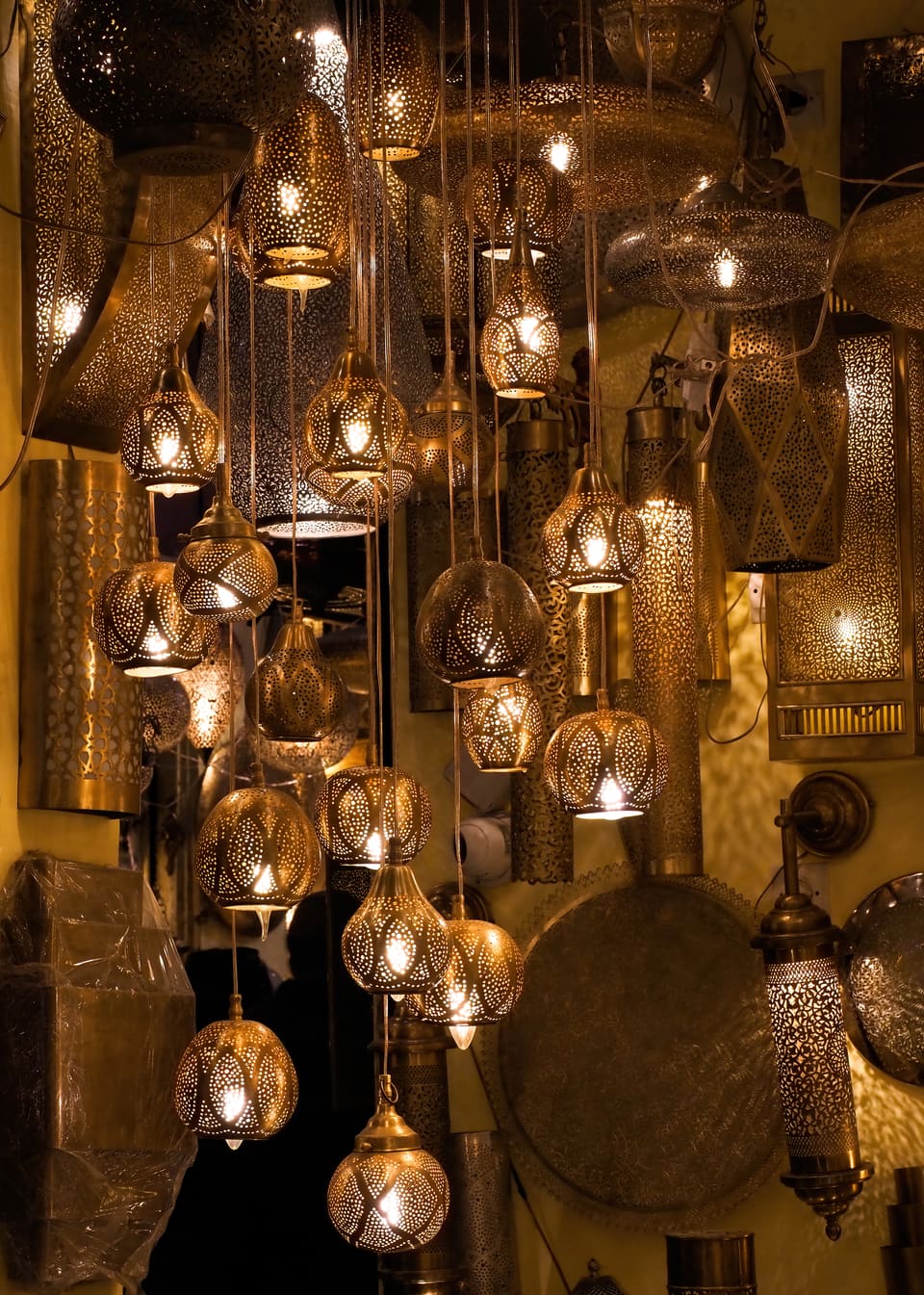
The medina has been a UNESCO World Heritage Site since 1985, and there's no charge to walk in. It's a working district, not one long market street, with homes, workshops, shops, mosques and restaurants all mixed together. The souks are grouped loosely by trade. Souk Semmarine is the place for leather, Souk el-Attarine for spices, Rahba Kedima for textiles and Souk Haddadine for metalwork. The grouping helps, but it isn't exact and signs change often. A shop selling lamps may also stock brass, mirrors and tourist goods.
A good first walk goes from Jemaa el-Fnaa to Bab Laksour, then back through the textile and leather souks. Other useful landmarks are Ben Youssef Madrasa, Koutoubia Mosque, Mouassine, Bab Doukkala and the entrance to the Majorelle Garden. An offline map helps, but the pin positions in the narrow alleys are often wrong. Take a photo of your hotel's name and ask the driver which gate is closest for cars. Plenty of riads can only be reached on foot, and some have no sign at all. When a driver says “two minutes by car”, that can mean ten minutes on foot.
Getting lost can be worthwhile, as long as you do it once and have a fixed route back. Choose a single craft or food category, wander its side streets, then head for the last big landmark you noted rather than following every appealing alley. That works better for shopping and watching than rushing between famous monuments. Keep your phone charged, buy water instead of accepting a free mint at every stall, and don't carry a large bag. Handcarts and motorbikes crowd the lanes. If you need directions, ask for a mosque, public garden or market by name rather than asking the way to the city gate, because several gates look alike from inside.
Koutoubia, Ben Youssef and Bahia Palace
Koutoubia Mosque is the landmark you can pick out most easily from Jemaa el-Fnaa. Its 77-metre minaret goes back to the 12th century and marks the western edge of the medina. The exterior, forecourt and streets around it are free. Access inside is limited and can depend on maintenance schedules, restoration work and prayer times, so it isn't worth building a whole day around getting into the tower. When it is open, tower admission is usually about 10 MAD for a foreign adult. The real point is the view of the minaret from the square, especially before dark, when its upper structure is lit against the sky.
Ben Youssef Madrasa is a short walk from the Koutoubia end of the souks, and it gives you a clearer look at Moroccan craft. Its 16th-century rooms hold zellij tile, carved cedar, painted ceilings and stucco cut with geometric and plant patterns. The central courtyard is the main space, but the side rooms and upper levels are worth a look. Admission is usually 50 MAD for an adult, with reduced rates for students and children. Mornings and the middle of the day are busy. Set aside 60 to 90 minutes, and save some energy for the market streets right outside the entrance.
Bahia Palace is bigger and more worn than Ben Youssef, with painted ceilings, zellij, courtyards and a run of reception rooms. It was built up in the 19th century and is often visited after the busier sights of the medina. The usual ticket for a foreign adult is 100 MAD, and the garden area is sometimes listed separately. Allow 90 minutes. A guide helps here, because the sequence of rooms doesn't explain itself, but agree the fee before you go in. If time is short, Ben Youssef gives you more decoration per square metre. Bahia is the better place to understand how the palace was lived in, rather than how a single madrasa was designed.
Majorelle Garden and the YSL Museum
Majorelle Garden is about 15 minutes away by taxi, or roughly 30 minutes on foot from the western edge of the medina. The garden costs about 100 MAD for a foreign adult, and the Yves Saint Laurent Museum in the former villa adds 50 MAD, so 150 MAD covers both. The site usually opens around 8 a.m. and closes between 5:30 and 7 p.m., depending on the season. It's compact, and a careful visit takes 90 minutes. The cactus beds, bamboo, water channels and intense blue buildings are often crowded, so arriving at opening gives you the best chance of walking round without a queue.
The blue belongs to the garden's history rather than to any recent decoration project. The French artist Jacques Majorelle bought the property in 1923 and used a distinctive cobalt pigment during the 1930s. Later restoration, along with support from Yves Saint Laurent and Pierre Bergé, kept the colour tied to the site. The YSL Museum, which opened in 2017, shows the fashion house's clothing, sketches, photographs and perfumes. Don't expect every plant or wall to be blue. The strongest examples are in the villa, the pots and the architectural details, and the museum works as a useful counterpoint to the garden rather than just carrying on the same visual idea.
Imlil, Toubkal and the Atlas villages
Imlil is about 90 km from Marrakech, usually 1.5 to 2.5 hours by minibus, taxi or tour vehicle. Taxis, mules and people carrying supplies make the last stretch of road busy, so a private driver is more comfortable if you're carrying a heavy bag. Imlil sits at roughly 1,740 metres and is the main base for walks into the High Atlas. The village has guesthouses, small supermarkets, a pharmacy and a cluster of vehicle offices. It's a practical place rather than a pretty one. For a quiet room, stay above the main road or on the edge of the village rather than next to the bus area.
People often talk about Toubkal as if the refuge and the summit were the same thing, but they're two separate parts of the walk. The refuge is at about 3,207 metres and offers basic shelter; the summit marker is at 4,167 metres. From Imlil, the usual route passes Aroumd and the Mizane gate, then climbs roughly 10 to 12 kilometres to the refuge. Allow 4 to 6 hours to get there and 2.5 to 3.5 hours to come down. A local guide generally costs about 300 to 500 MAD for a group for the day, and mules are around 100 to 150 MAD each. The mules carry baggage only as far as the end of the vehicle track, not to the summit.
The Amazigh, also called Berber, villages around Imlil include Aroumd, Tazarart and Ouled Ousalem. Aroumd is a short walk from the village centre, while Tazarart lies roughly 8 to 12 kilometres beyond it, depending on the route. A visit to a village cooperative can include tea, bread and an explanation of how argan oil is made. Ask before photographing people, and don't expect every shop to run like a formal visitor centre. In winter the trails can be icy, and the upper paths can hold snow. Wear proper boots, carry 1.5 to 2 litres of water and start before 7 a.m. A clear sky down in the valley doesn't mean the ridge is safe.
Erg Chebbi and the road through Ouarzazate
The Sahara doesn't work as a day trip from Marrakech. Erg Chebbi, the dune field near Merzouga, is about 530 km from the city. The usual trip takes two full days with one night in the desert, though longer tours add another day and a second camp. A standard shared 4x4 for two to four people usually costs 1,200 to 2,200 MAD per person, while a private vehicle can cost 4,000 to 7,000 MAD for the group. Check whether meals, a shared room at a hotel in Merzouga, the camp, entrance fees and the return journey are included in the price. A cheap one-day excursion usually means a very long drive and little time on the dunes.
The route heads south through the Ouarzazate valley and over the Tizi n'Tichka pass, which climbs to about 2,260 metres. Marrakech to Ouarzazate is roughly 190 km, close to three hours. From Ouarzazate the road crosses the Skoura palm belt, passes near the Tinehdar palm grove and follows parts of the Ounila and Draa valleys to Merzouga. The Ouarzazate to Merzouga leg is around 280 km and takes 4.5 to 5.5 hours. Roadworks, police stops and overloaded trucks can add time, so don't attempt this route after dark in an ordinary car.
The dunes of Erg Chebbi rise to roughly 150 metres and start about 10 to 15 km from Merzouga. Most camps lie outside the village and are reached by a rough track; the final climb takes 60 to 90 minutes, depending on the heat. A simple camp with a shared washroom, dinner and a mattress generally costs 300 to 700 MAD per person when booked separately, while better camps with private facilities cost more. At night the sand can drop below 10 degrees even when daytime temperatures pass 30. Bring a warm layer, a headlamp, closed shoes and a dry bag for your phone and camera. The night sky is clear, but the wind can blow until well after midnight.
Ait Ben Haddou and the Moroccan film route
Ait Ben Haddou is about 180 km from Marrakech and 30 minutes from Ouarzazate, so it can be added to a desert journey instead of costing you a separate long day. The fortified village has been a UNESCO World Heritage Site since 1987. Its earthen houses, defensive walls and towers are laid out on a hillside above the Ounila River. The usual entrance fee is about 60 MAD for a foreign adult. A guide costs roughly 150 to 300 MAD for a group. The walk through the upper village is steep and uneven, but the main lanes take 60 to 90 minutes.
Ait Ben Haddou has been a filming location for Gladiator, Alexander and Lawrence of Arabia, and it stood in for Yunkai in Game of Thrones. The film set used for the larger constructed scenes is near Ouarzazate and is separate from the inhabited kasbah. People still live in Ait Ben Haddou, so visitors should stay on the public routes. A standalone day trip from Marrakech usually lasts 10 to 12 hours and costs 300 to 600 MAD per person. If your desert tour already passes Ouarzazate, ask whether Ait Ben Haddou can be included without adding several hours to the drive.
Planning time, money, transport and the medina week
Allow four full days in Marrakech and two days for the Sahara. That's six active days, plus the time you need to get into the country and leave again. A city sequence that works: Jemaa el-Fnaa and the souks on day one, Koutoubia, Ben Youssef and Bahia on day two, Majorelle and the YSL Museum on day three, and Imlil or a slower day in the medina on day four. Tickets for the main city sights come to about 310 MAD: 150 for Majorelle and the YSL Museum, 100 for Bahia, 50 for Ben Youssef and 10 for Koutoubia when the interior is open. The medina itself is free.
The best seasons are March to May and September to November. March and April bring warm days, cool evenings and dependable access to the High Atlas, though the desert can still turn hot by noon. May can be hotter. September and October are usually easier going, while November has colder mornings in the mountains. Marrakech regularly reaches 35 to 40 degrees in July and August. High Atlas trails may hold snow from December through February, and desert nights can be cold. Ramadan changes opening hours and cuts daytime service in some areas, so confirm bookings and attraction schedules in advance.
Marrakech Menara Airport is about 20 to 30 minutes from the central medina in normal traffic. The airport bus, usually labelled route 19, runs into the city and costs roughly 30 to 40 MAD. A petit taxi or ride-hailing car should cost around 100 to 150 MAD, but agree the fare before you set off, since the meter is usually not used. From central Casablanca, ONCF runs daytime trains of about three hours and overnight trains of roughly 6 hours 45 minutes to 7 hours 30 minutes. An overnight second-class berth generally costs 250 to 350 MAD. The Marrakech station is about 15 minutes from Jemaa el-Fnaa by taxi.
A riad in the medina is worth the effort, but book before you arrive and send the exact address to your driver. A simple riad with breakfast commonly costs 900 to 1,800 MAD a night, while highly designed places can pass 2,500 MAD. Choose between the Jemaa, Ben Youssef and Mouassine areas depending on how much noise you can take. A room over Jemaa el-Fnaa may have a fine view and a loud square underneath. Check whether the building has stairs, whether the room has a window and whether the courtyard in the photos is shared. Agdal and Gueliz have more conventional hotels, easier taxi access and less noise for 600 to 1,200 MAD.
For cheap food, eat at the Jemaa stalls or around the market streets, but check prices first. A solid breakfast of bread, eggs, jam and tea usually costs 20 to 40 MAD. Lunch at a long-running restaurant is a more predictable bet. Al Fassia on Boulevard Zerktouni, for example, usually serves a meat tagine with salad and bread for about 100 to 160 MAD, though it's worth confirming the current price and lunch hours. Mint tea costs roughly 15 to 25 MAD in a market cafe. A plate of pastries with four glasses of tea is often 80 to 150 MAD. Carry small notes, because the best street stalls rarely take cards.


Marrakech, the Atlas and the Sahara, Morocco
A neighbourhood hammam costs roughly 10 to 30 MAD for basic washing, soap and steam. Tourist baths and spas charge about 150 to 400 MAD, depending on the scrub, massage, private room and length of the session. Ask for the full cost before you undress. A traditional session takes 60 to 90 minutes and covers heat, steam, exfoliation and a final rinse. Bring a towel, flip-flops, a change of clothes and a plastic bag for wet items. Anyone with heart problems, a serious skin condition or difficulty standing should talk to a doctor first. It's also worth checking whether massage and grooming are included rather than added later.
Haggling is expected in the medina's craft and textile shops, though it's less theatrical now than older guidebooks suggest. If you plan to buy, ask the price, then offer around 60 to 70 percent of it and be ready to meet in the middle. Walking away works better than arguing for several minutes. Government shops, supermarkets and many cooperatives have more fixed prices, so haggling there can feel needlessly abrasive. Don't bargain over food, taxi fares or a guide's agreed daily rate. Look leather, rugs and metalwork over carefully, get written terms for a carpet or any major purchase, and walk away from anyone who turns hostile when you decline.
A warning for Fridays: the medina is at its most closed to non-Muslims. Many souks and small workshops shut for the day, access to some residential alleys is restricted, and the main mosque prayer areas are not open to non-Muslim visitors. Jemaa el-Fnaa, restaurants, the main arteries and some larger shops stay open, so the medina doesn't seal off completely. Do your craft shopping on another day. It's also worth avoiding rooftop restaurants where staff push menus at passers-by, unofficial guides who turn up at every corner, photos involving aggressive animals and trips on remote roads after sunset. Keep emergency numbers, your riad address and a cash reserve offline.
A practical budget is about 350 to 700 MAD per person for an ordinary day in Marrakech, not counting lodging, shopping and the desert. A shared riad room can add 450 to 900 MAD per person per night. A day in Imlil with transport and a guide generally costs 300 to 700 MAD per person, while a standard two-day Erg Chebbi trip runs 1,200 to 2,200 MAD. Carry cash for souks, drivers, small cafes and desert camps, and use an ATM rather than changing money at the airport. Book the riad, the YSL Museum and the desert vehicle before you travel, leave one afternoon in the city free, and keep the Sahara and the High Atlas on separate days rather than trying to cover both in one rushed route.
From readers
Traveller experiences
Personal notes and ratings from readers who have been to Marrakech, the Atlas and the Sahara.
Checking your session…
No experiences yet.
Sign in to be the first reader to describe this place.
Keep reading
More stories from this collection are coming.