
Pokhara and the Annapurna Footprint: A Practical Field Guide
Pokhara sits below the south face of Annapurna, and three viewpoints decide whether you actually see the mountain.

Pokhara, lake city and trailhead
Pokhara sits at 822 metres in Gandaki Province, at 28.2096, 83.9856, on the eastern shore of Phewa Lake. Annapurna South rises directly north of the city, with Machhapuchhre, Hiunchuli and the rest of the range walling off the valley. This is a working commercial city, with heavy traffic and constant construction; it is not a quiet lakeside retreat. The waterfront is free to enter, and the lake, a hill to the north and a trailhead for the Annapurna Footprint all sit close together.
The Annapurna Footprint is travel shorthand, not the name of one official trail. It takes in the villages, paths and viewpoints north and east of Pokhara. Ghandruk and Australian Camp are the day-trip versions; Annapurna Base Camp and Machhapuchhre Base Camp are multi-day treks. Three places decide whether you see the range properly: Sarangkot has the widest dawn panorama, Ghandruk or Australian Camp gets you closer to the southern face, and the Peace Pagoda frames the lake and the mountains together. Weather can still ruin all three, so allow two days for Pokhara itself, or three if you add a flight.
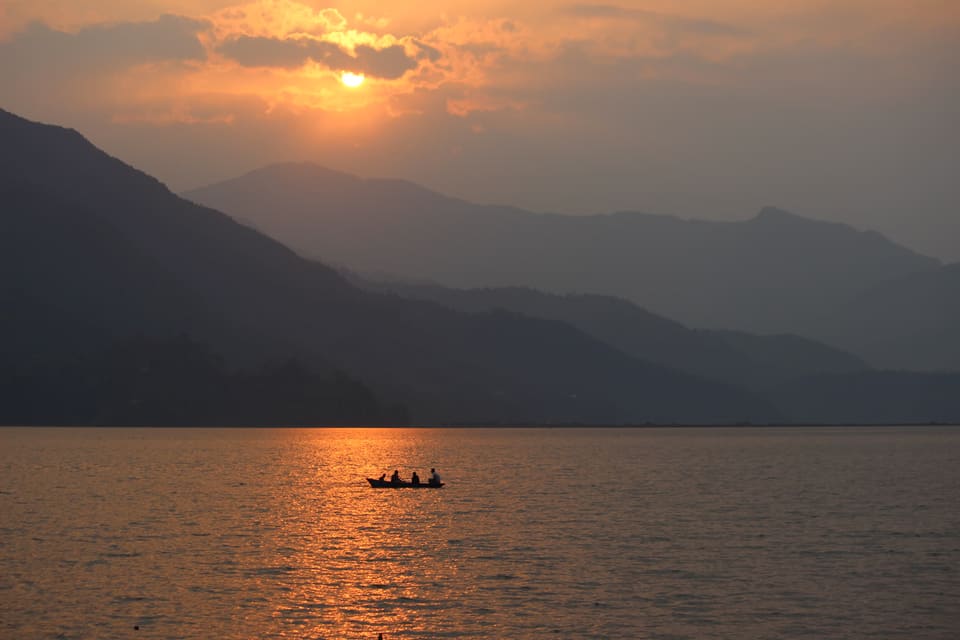
Phewa Lake: promenade, rowing boats and Tal Barari
The built-up promenade runs for about 3 kilometres along the eastern side of the lake. It is at its best before 7 a.m., when the traffic has thinned, runners are out and the hotels on that side are starting breakfast. By late morning, delivery scooters, taxis, tour buses and hawkers are all fighting for the same narrow strip. Walk on the lake side of the road when you can. The water is calm at dawn, and the first sunlight hits the Annapurna foothills before it reaches the lake.
Official boat counters near the main jetties issue numbered tickets. The posted rate is usually around NPR 500 for 30 minutes in a rowing boat, or NPR 800 to NPR 1,000 for an hour. You can also hire pedal boats and take short motorboat trips, but the motor trips are brief and no real substitute for rowing. Bring cash, ask whether the price includes landing on Tal Barari, and make sure the life jacket fits before you leave the counter. Prices can change during the busy October and spring periods.
Tal Barari, the small island in the middle of Phewa Lake, is about 10 to 15 minutes away by boat when the water is calm. It has a Buddhist stupa, meditation shrine rooms, tea sellers and a concrete landing. It is quieter than the promenade, but it is not an untouched retreat, and the temple or meditation rooms may keep their own hours. Some boatmen just circle the island instead of landing, so agree on the fare and the stop before you get in.
Do not swim in Phewa Lake. It takes in urban stormwater, poorly treated runoff and waste from a large city catchment. All those nutrients feed algal growth, and the shallow edges are silty and often lined with reeds. Local authorities and health guidance do not consider the lake safe for bathing. Rowing, pedalling and looking across the water are fine. Wading in for a photograph is not worth the bacterial, parasite or water-quality risk.
Sarangkot: the dawn that may not arrive
Sarangkot sits about 12 kilometres north of central Pokhara, roughly 1,500 metres above the city. A taxi takes 35 to 50 minutes depending on traffic and usually costs NPR 1,200 to NPR 2,500 one way. A shared jeep is cheaper, often NPR 500 to NPR 1,000 per seat, but you are at the mercy of the other passengers. Book a car the evening before, leave Pokhara between 4:40 and 5:00 a.m., and expect a 10- to 15-minute uphill walk from the viewpoint car park to the main terrace.
From late October through February, sunrise comes around 5:55 to 6:10 a.m.; near the March equinox it is closer to 6:10 or 6:15. Get to the terrace by 5:25 and you have time to watch the light change before the sun clears the ridge. A rough local rule of thumb says the cloud stays on Annapurna after sunrise about one morning in three. That is not an official weather statistic, but it is a useful way to plan. On a bad morning the cloud may lift at 7:30, or it may hang over the range until midmorning.
On a clear morning the terrace opens up a broad view across Annapurna I, Annapurna South, Hiunchuli and Machhapuchhre. Dhaulagiri and Manaslu can show up too when the air is clean. This is a skyline view, not the close-up you get from Ghandruk. The viewpoint gets crowded between 6:00 and 7:00, especially on Saturdays and in peak season. Tea at the roadside stalls costs about NPR 100 to NPR 200, and those early prices beat a sandwich from a lakeside hotel.
“At 5:15 the sky is often clean. By 6:30 it can be finished. Wait until 7:30, then accept that the mountain has said no.” Dipa Rai, who runs a tea stall by the Sarangkot viewpoint car park, gave me that rule during a wet November.
World Peace Pagoda: walk above the lake
The World Peace Pagoda stands on a ridge north of Phewa Lake at about 1,500 metres. Start at the northern end of the Lakeside strip and follow the uphill road for roughly 3 kilometres. The route climbs around 550 to 650 metres and takes 60 to 90 minutes at an ordinary walking pace. A local bus will get you close to the top for a few hundred rupees, but it saves little if you want the full view. The path is steep in places, exposed to traffic fumes and slippery after rain.
Entry is usually around NPR 100 for a foreign visitor, with a lower charge for SAARC nationals, though the fee can change. The centrepiece is a Buddhist Shanti Stupa, and the complex also has Hindu and other religious spaces. From the upper terrace you look down over Phewa Lake, the city and the southern trailhead, with Annapurna beyond. It is neither as high nor as wide as Sarangkot, so come for the combined lake view rather than as a substitute for the dawn panorama.
International Mountain Museum and the old bazaar
The International Mountain Museum is a good rainy-day stop near Seti Maula in the old part of town. Published hours are generally 9:00 to 17:00, and many listings show Wednesday as the weekly closure, so check before you build a tight itinerary around it. A foreign adult normally pays NPR 300, SAARC visitors NPR 150, and Nepali citizens get in free. Allow 60 to 90 minutes for the climbing models, maps, expedition gear, photographs and displays on Sherpa and other mountain communities.
The old bazaar is where Pokhara began. Trade routes from Tibet and Muktinath crossed the Annapurna region on their way to the Terai, carrying salt, grain, wool, livestock and manufactured goods. The market around Seti Maula is still a working district of food stalls, repair shops, guesthouses and old courtyards, not a preserved film set. It is about a 10-minute walk from the museum towards the river. The lanes are worth exploring, but traffic, delivery vehicles and pushy shopkeepers make the area less peaceful than the lake.
Ghandruk and Australian Camp: the second tier of viewpoints
Ghandruk is a Gurung village at 2,012 metres. The usual trek starts at Birethanti and climbs roughly 13 to 14 kilometres, with about 900 to 1,000 metres of ascent, in four to five hours. A jeep from Pokhara takes around 3.5 to 4.5 hours to the roadhead, though the road can be slow or closed after heavy rain. Jeeps sometimes cut two hours off the trip by getting as far as the Hinku Cave area, but a rough road is not the same as a direct ride into the village.
Australian Camp is another 3 to 4 kilometres beyond Ghandruk and about 500 metres higher, at roughly 3,280 metres. The walk takes around 2.5 to 3 hours. Ghandruk gives you a closer line on Annapurna South and Hiunchuli than Sarangkot does, while Australian Camp opens up the view across the pasture settlements towards Annapurna I and the high peaks. The higher ground is colder and more exposed, so it can be under cloud even when the lower valley is clear. You can walk it from Pokhara in a day, but it is tiring. Staying overnight in Ghandruk is the sensible choice.
Australian Camp is the place that changed its name. Older maps often call it Australian Base Camp, while current tourism material and most booking pages use Australian Camp. The area once served as a staging point for Australian expeditions, but today it is a cluster of lodges, houses and seasonal pasture camps. It is not an active expedition base, and it is not Annapurna Base Camp. Mixing up those names leads travellers to expect a short viewpoint visit when the real Annapurna Base Camp trek takes seven to ten days.
Seti River: noise under the boulders
People often call the Seti Nepal's loudest river, and at Seti Maula it is easy to hear why. The amount of water you can see at the surface is not especially large, but it is forced through a maze of unstable glacial boulders, fractured limestone, gravel and underground cavities. That movement produces a deep roar that carries across the old bazaar. The noise is as much geology as water volume: the river is moving through a broken, porous system rather than a smooth channel.
Do not swim here or climb onto the boulders for a photograph. The current is fast, the rocks are slippery and the depth is unpredictable. The 2014 Seti flood swept away homes and bridges around Pokhara, which is a reminder that the quiet gravel bed is not a safe place. Rain in the upper catchment can raise the river before heavy rain reaches the city. Watch it from the bridges, the museum side and the paths above the gorge, and stay off the riverbed after several days of monsoon rain.
Paragliding over Phewa
A standard tandem flight launches from the hillside above Sarangkot at about 1,500 metres and lands by the lake near the Lakeside strip, roughly 700 metres below. The flight lasts 20 to 30 minutes. A 20-minute ride usually costs US$35 to US$45, or about NPR 5,000 to NPR 6,500. A 30-minute flight is commonly US$50 to US$65, or NPR 7,000 to NPR 9,500. You pay per passenger and per flight, not by the hour. Ask for the full written price, including insurance, landing fees and any camera charge.
Check out the pilot before you pay. Ask for a Nepal Aviation Authority licence, look at recent entries in the pilot's logbook and confirm passenger insurance. A stated passenger limit of 85 to 100 kilograms is common, though the real limit depends on the pilot and the harness. The pilot should have a reserve parachute, a helmet, a radio and a correctly adjusted harness. Ask what happens if the wind is wrong, and whether you get a full refund or a rebooking if the launch is grounded. Pay the registered operator directly and get a receipt, not a street seller's voucher.
A full beginner course takes about six to nine days and costs roughly US$500 to US$800, depending on whether transport, accommodation and training flights are included. It covers weather theory, ground handling, walking to launch sites, supervised high flights, solo flights and landings under an instructor. A shorter taster course may include one or two tandem flights, but that does not give you a licence. Monsoon cloud, unsafe wind or a wet launch will stop flying, so leave a spare day instead of tying a flight to an international departure.
“Check my licence, then ask to see my last three flights in the logbook. If I cannot do both, walk away.” Sanjay Gurung, a Pokhara-based paragliding pilot, makes the test simple.
How many days to allow
Give Pokhara at least two days. On day one, head for Sarangkot before dawn, come back for breakfast, row on Phewa Lake, then visit the museum and the old bazaar. Use day two for the Peace Pagoda or for a full Ghandruk and Australian Camp walk, not both. Australian Camp is a demanding day trip, so if you want a relaxed visit to Ghandruk, add a night there. The full Annapurna Base Camp trek needs a week of its own.
Allow three days if you plan to fly. Give paragliding a day of its own, because wind, cloud and a delayed launch can push it to the next morning. Do not book a flight on the same day as a long trek, a bus to Kathmandu or an international flight. If the operator says the conditions are unsuitable, take their word for it. A third day also gives you a second shot at Sarangkot if the first dawn is cloudy.
When to go
October to November is the most reliable window for clear Annapurna peaks, especially from Sarangkot, Ghandruk and Australian Camp. Mornings are usually cold enough for a jacket, while daytime temperatures in Pokhara are comfortable. Visibility can be excellent for several mornings in a row, though it is never guaranteed. March and April are the best months for rhododendrons on the lower trails around Ghandruk, with the flowers usually appearing from the second half of March into April.
The June to September monsoon brings heavy rain, muddy trails, swollen rivers and frequent flight cancellations. Some mountain roads and lodges close for part of the season. December to February can bring very clear air and snow-covered peaks, but the viewpoints are cold and frosty, and sunrise comes later. Check local and regional forecasts instead of relying on a general Nepal forecast, and remember that a clear valley does not guarantee a clear summit.
The first-week-of-October warning
Avoid arriving in the first week of October. Dashain dates shift each year, but the festival travel rush starts before the official holiday and puts the national road network under severe strain. Tourist buses can take twelve hours or more, domestic flights fill up or cancel, and Pokhara hotels push their rates up sharply. Every main travel corridor is effectively at capacity during the busiest days. If your dates are fixed, travel at least a week before or after Dashain, book transport early and keep a spare day in Pokhara before moving on.
Getting there from Kathmandu
The flight from Kathmandu to Pokhara takes about 25 minutes in the air. Allow 30 to 40 minutes door to door once you factor in the airport transfer, security and baggage. One-way tickets commonly cost US$110 to US$180, with the exact fare depending on the airline, season and baggage allowance. Pokhara Airport is about 15 minutes from the Lakeside strip by taxi, usually NPR 500 to NPR 1,000. Book the domestic flight and any luggage weight limits together instead of assuming your international ticket covers everything.
A tourist bus from Kathmandu takes about seven hours in normal conditions. Fares generally run from NPR 1,000 to NPR 3,500, depending on the operator and the seat. The bus stops near central Pokhara, usually within a 10- to 15-minute walk of the lake. Seven hours is not a promise during the monsoon, landslides or the Dashain rush, when the trip can stretch to twelve hours. Carry water, keep your valuables with you and get off for a break when the traffic is at its worst.
What it costs
Phewa Lake and the promenade are free to enter. A 30-minute row costs about NPR 500, an hour about NPR 800 to NPR 1,000, and the International Mountain Museum charges NPR 300 for a foreign adult. The Peace Pagoda normally charges about NPR 100. A Sarangkot taxi is around NPR 1,200 to NPR 2,500 one way, while a shared jeep is NPR 500 to NPR 1,000 per seat. These are working price ranges, not fixed tariffs, so confirm the amount before a longer trip.
For Ghandruk and Australian Camp, foreign trekkers need an Annapurna Conservation Area permit and a Trekkers' Information Management System card. The conservation permit is usually NPR 3,000 for foreign nationals, NPR 1,500 for SAARC nationals and free for Nepali citizens. The TIMS card is normally US$20 for foreign trekkers, with a separate SAARC rate. Check the current tariff before you leave. A licensed guide for a full day around Ghandruk usually costs NPR 4,000 to NPR 7,000, not counting your permit, meals and overnight accommodation.
A paragliding flight starts at around NPR 5,000 to NPR 6,500 for 20 minutes, while a full beginner course runs roughly US$500 to US$800. Midrange lakeside rooms commonly cost NPR 3,000 to NPR 6,000 a night, with simpler guesthouses below that in normal periods. A simple meal costs NPR 250 to NPR 500, tea NPR 100 to NPR 250, and a hotel breakfast NPR 300 to NPR 800. Carry NPR 10,000 to NPR 15,000 for a day of meals, taxis and small fees. There are ATMs at Lakeside, but keep cash for tea stalls, boats and trail villages.
Where to stay and eat
The lakeside strip is the obvious choice, and the best one for a first visit. Lake access, restaurants, taxis, the museum and the Peace Pagoda road are all within walking distance, and a wet day still leaves you somewhere to eat and wait. If traffic noise bothers you, choose a room one street back from the main road. A Sarangkot guesthouse is useful for a serious dawn attempt, while Ghandruk lodges are basic but save several hours of walking. Book early for October, November and the rhododendron season, and expect a sharp price rise during Dashain.
The strip has the widest choice of restaurants, from cheap noodle shops to hotel kitchens serving dal bhat, pasta and international food. A simple dal bhat usually costs NPR 250 to NPR 500, momos NPR 100 to NPR 250, and a Thakali khaja set meal NPR 500 to NPR 900. For a traditional meal, try a busy thakali kitchen in the old bazaar or Bhojan Griha, where a fixed meal with cultural entertainment generally costs NPR 2,500 to NPR 4,500. Confirm the current menu and performance times. Wash your hands before eating, and pick stalls with a steady stream of local customers.
What to avoid


Pokhara and the Annapurna Footprint, Nepal
Do not swim in Phewa or the Seti, walk into the Seti gorge or stand on wet boulders for a photograph. Do not fly with a paragliding pilot who cannot show a licence, a recent logbook and passenger insurance. Do not confuse Australian Camp with Annapurna Base Camp. Avoid a two-day plan that tries to include every viewpoint: almost all of them are uphill, and a lost weather window cannot be recovered. Taxis should have working seat belts, and you should agree the fare before leaving the hotel.
Watch for monkeys around Phewa Lake and Swayambhunath, where they grab food, bags and loose phones. They are not harmless scenery, so do not feed them or leave food on a table. From March through September, wear socks or gaiters on the Ghandruk trails to reduce leech bites, and carry a rain shell and spare dry footwear. During the monsoon, do not cross swollen streams or follow trails cut into landslide slopes. Local advice is more useful than a national weather app when you need to know whether a path is open.
Final field checklist
Carry your passport, permits, NPR 10,000 in cash, a warm layer, a waterproof, sun protection and shoes with grip. Download offline maps, save the museum and operator addresses, and check flight and road conditions again 48 hours before departure. Confirm the museum is open and that your Sarangkot driver will collect you at 4:40 a.m. If the first dawn is cloudy, do not spend the whole day waiting. Go back to the lake, visit the museum and old bazaar, and save the serious viewpoints for a better forecast.
From readers
Traveller experiences
Personal notes and ratings from readers who have been to Pokhara.
Checking your session…
No experiences yet.
Sign in to be the first reader to describe this place.
Keep reading
More stories from this collection are coming.