
The Valley of a Thousand Temples: Walking Kathmandu, Patan and Bhaktapur
How thickly temples crowd the Kathmandu Valley — and what a traveller really sees once they stop counting pagodas and start looking at them.

At 27.7149° N, 85.3111° E, you are in central Kathmandu, close to the old city's temple and palace districts. The wider place is not a single walled enclosure holding a thousand buildings, though. It is the Kathmandu Valley, a basin of three old cities, religious suburbs and sacred landscapes, all of it now within Bagmati Province. Since 1979, UNESCO has listed the valley's main Buddhist monastic zones and pilgrimage sites under the official name Buddhist Monastic Zones and Pilgrimage Sites in the Kathmandu Valley. The Valley of a Thousand Temples is just a nickname for how tightly packed this larger landscape is.
No one keeps a live count of every shrine in the valley, so the thousand is better read as a practical description than an audited total. UNESCO groups the valley's main sacred precincts into seven monument zones. These take in the great Buddhist sites at Boudhanath and Swayambhu, the old cities of Kathmandu, Patan and Bhaktapur, and pilgrimage centres such as Changu Narayan. Estimates go up or down depending on whether you include a forecourt shrine, a private house temple or a single carved niche. The number matters less than the pattern. In the old cities, no boundary separates a temple from daily life. It stands beside kitchens, workshops, shops, guesthouses and family homes.
No official ranking of temple density exists, but the strongest day-to-day concentration is in Bhaktapur's old lanes, especially between Taumadhi and Durbar Square. Patan and central Kathmandu come close behind, with courtyard temples, house shrines and carved gateways packed into short blocks. Boudhanath and Swayambhu are remarkable concentrations too, but each is mainly one huge monument rather than a fine-grained old-city network. Counting roof finials is not the useful exercise. Many carved buildings are private shrines and some are no longer in regular use. Look instead for swept thresholds, fresh flowers, lamp soot, food left at a doorway and people whose routines include the building.
How a Newar Pagoda Is Built
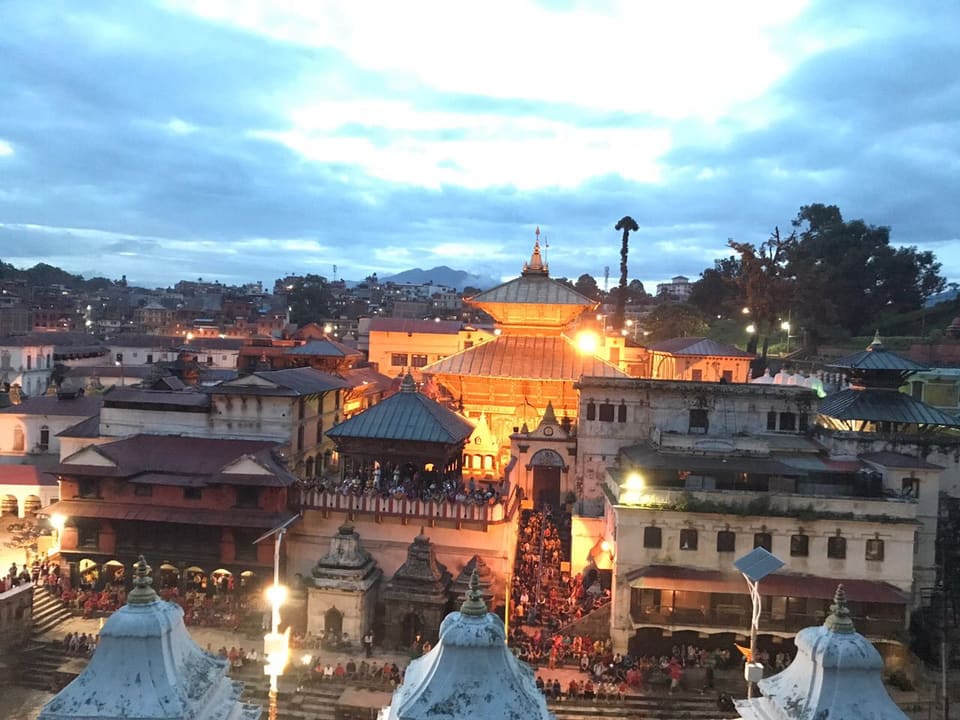
A Newar pagoda is a specific regional building form, not a loose term for any ornate temple in Nepal. Most are square in plan and stand on a stone plinth. A timber frame carries two or three diminishing upper floors, with brick walls and infill set between the structural members. Each floor has a broad, gently sloping roof covered in fired tiles. Carved brackets hold up the deep eaves, while carved beams, doorframes, windows and finials do much of the decoration. The upper storeys shrink as they rise, which gives the valley its familiar skyline of diminishing roofs and gilded points.
Building one is specialist work, done in sequence. Stoneworkers prepare the plinth; carpenters put together the main beams and columns; masons build the brick walls; roofers tile each shrinking storey; metalworkers cast or beat the finial and the ornamental fittings. Fine carving might be added months or years later, often by a different workshop. Traditional frames use fitted timber joints and flexible connections, which help a building settle and move in an earthquake. That does not make them earthquake-proof. The 2015 earthquake still caused extensive damage. What has let many temples survive is a light upper frame, skilled repair, regular maintenance and communities that keep treating damaged structures as buildings worth repairing.
The valley has more surviving Newar pagodas in active use than any comparable urban area on earth. Several conditions produced that concentration. Kathmandu, Patan and Bhaktapur were separate capitals, each with royal courts, large craft communities and residents who needed neighbourhood institutions for worship, festivals, meetings and settling disputes. The basin sat on trade routes between the Tibetan plateau and the Indian plains, which brought wealth and donors into the valley. Timber came from the surrounding hills, brick was made locally, and specialist Newar carpenters, metalworkers and ritual specialists could keep up a demanding building culture. Temples also acquired land, shops and service rights, so they had income that came back every year. The architecture spread because there were thousands of deities to house, thousands of households to support them and enough patrons to pay for both building and repair.
Bahal and Bahal Bahal
A bahal is an open courtyard, usually enclosed on one or more sides by single-storey temple buildings, homes and covered passages. It is a spatial arrangement, not the name of a single deity. A bahal bahal has a second storey built around the same central void, which makes a courtyard on two levels. In everyday use, a bahal might be the main public face of a shrine, with worship centred at ground level. A bahal bahal adds an upper ring of rooms, galleries and balconies. These spaces have served as meeting rooms, storage areas, living quarters, offices and protected routes for ritual processions.
Patan has the clearest examples. The passage through the Golden Gate leads into a sequence of courtyards, among them the large two-storey complexes of Keshav Narayan Chowk and Mani Keshab Narayan Chowk, plus a palace-associated bahal bahal. The upper galleries change the scale at once: the street gives way to a framed court, then to another court seen from above. Bhaktapur's Taleju and Pashupati compounds show the single-storey logic more plainly, with the main buildings defining the court at ground level. The difference matters to a visitor because access is not automatic. An upper gallery may be a family home, an office or part of a working shrine. A locked door does not mean the building is out of use, and a fee does not always cover every level.
How Godawari Keeps a Temple Running
Godawari is the financial and practical base of many valley temples. The word covers both a contribution and the obligation that comes with it. Households may give cash, rice, grain, cooking oil, cloth or labour, depending on the temple's custom. A committee records what each household has pledged and calls it in at intervals or through an annual cycle. Some old shrines also receive endowments of farm land, shops, rents or rights to collect particular dues. Those assets supported the temple long before entrance tickets, conservation grants or tourism income existed.
A guthi, or household association, usually runs the shrine. Its office-bearers, sometimes a head, secretary and treasurer, rotate among the members. In some compounds, cleaning, watching the door, festival preparation and even a literal night watch are handed out in turns, with one household responsible for a few days or for a festival period. The arrangement spreads money, work and authority across families, rather than leaving one rich donor in permanent control. Elsewhere, committees now hire attendants, guards and cleaners because the pool of volunteers has changed. The title of caretaker may sound casual, but the job can include protecting images, locking the shrine, arranging priests and handling cash.
One sensible place for this guide to set out the system in plain terms is Patan, where a fictional guthi secretary called Mina Shakya explains it as a duty to the neighbourhood rather than a tourist attraction.
“A temple stays alive because neighbours keep showing up with money, time and work.” Mina Shakya, a Patan guthi secretary
Godawari has paid for daily lamps, incense, rice, flowers, priest or household-priest services, cleaning, music, food, festival banquets, storage and roof repairs. It is not a sentimental relic untouched by modern life. The exchange is more and more cash-based, annual costs have risen, and some committees struggle to bring in younger members. Historic systems could be restrictive too: rights were tied to particular families, and contributions created a claim to control. Visitors should remember that a community shrine is not a public utility. Access may depend on the day, the rite, the festival committee and the goodwill of the caretaker.
The Newar Calendar and Its Festival Seasons
The Newar calendar is lunisolar, divided into twelve months, and its solar new year falls around 13 or 14 April. Festival days follow lunar calculations, so their Gregorian dates shift from year to year. The calendar's rhythm also shapes how temple work is shared out. A temple may keep a small caretaker year-round, but its main annual festival needs temporary cooks, musicians, decorators, priests, volunteers and visiting households. For those few days, a normally quiet shrine can run a crowded public operation from dawn until well after midnight.
The best-known events include Bisket in Bhaktapur around the new year, when chariots pass through the streets; Potha in Bhaktapur in January or February; Janai Purnima in Patan in July or August, centred on the image of Machhendranath; Indra Jatra in Kathmandu in August or September; Dashain in September or October; and Gai Jatra, Bhai Tika and Lakshmi Puja in October or November. Buddha Jayanti falls in April or May and brings a burst of activity to Swayambhu and Boudhanath. These are not citywide holidays on one shared schedule. Each temple celebrates its own deity, procession and calendar, sometimes over several days.
Any month works, but if you want to see the temples at full force, the festival calendar is the best reason to come. The trade-off is footfall. Indra Jatra, Janai Purnima and the main Dashain days can bring several times the usual number of people, with processions taking over streets and some inner courtyards reserved for participants. It is best to plan a festival visit as a cultural event, not a quiet architectural walk. Check the date for each city and temple, arrive early, and accept that access, parking and public transport will all be worse than on an ordinary weekday.
The Newar Communities Around the Temples
The Newar are the valley's main indigenous urban community, and many old neighbourhoods still revolve around temples, bahals and guthis. Newar is spoken as Nepal Bhasa and written in scripts including Ranjana and Bhujimol. Religious identity within these communities is not a simple divide. Some Newar Buddhist households keep Hindu tantric shrines, while Buddhist monasteries and Hindu temples can share streets, donors and festival rhythms. The valley is also home to large Tibetan, Tamang, Gurung, Sherpa, Limbu, Madhesi and other communities. A visitor should not assume that everyone around a temple shares the same identity or belief.
Temple-linked work supports livelihoods and family roles that go back a long way. Patan is known for metal casting, including ritual bells and images, while Bhaktapur's potters, woodworkers, mask makers and textile producers supply religious and household goods. Priests, shrine custodians, ritual musicians, carpenters and mask dancers are not just performers for visitors. Their authority and income can depend on family lineage, apprenticeship, ritual duty or a contract with a guthi. Economic change affects these jobs directly. A workshop may split its output between temples, household commissions and tourists, while a family that once supplied a shrine free of charge may now have to pay cash for flowers, food or specialist repair.
The 2015 earthquake sped up that change. UNESCO reported 203 monuments fully or partly damaged, including 48 destroyed. Restoration mixes traditional timber work, salvaged carved panels and reinforced concrete, with decisions driven by cost, donor preference and the need to get communities open again quickly. Since then, old houses have been repaired, subdivided or turned into guesthouses, and rising rents have changed who lives beside the shrines. Migration, plus younger generations' work and education, has made volunteer rotas harder to keep going. At the same time, festivals have taken up amplified sound, livestreaming and online promotion. The rites carry on, but the institutions behind them are adapting rather than frozen in time.
Daily Puja, Dawn Milk and Evening Aarti
The daily round is the clearest sign that these are working religious buildings. In many courtyard shrines, the first service starts before the general public arrives. The caretaker unlocks the sanctuary, cleans the image and the room, changes the cloth, washes the deity's feet and offers water, rice, flowers, incense, light and prepared food. A priest, a householder-priest or a Buddhist lama then recites prayers and rings a bell. In larger tantric bahal, the central image may stay covered until the right part of the puja. Duties and opening times vary, but first-light services commonly fall between about 5 and 7 in the morning, with a second round near dusk.
The best-known dawn milk offering is at Nag Pokhari, the serpent shrine beside Patan's Durbar Square. From first light until roughly 7 in the morning, devotees bring a small amount of milk for Nagraj, the snake deity believed to protect the valley from flood. Temple attendants take the offering and feed the resident snakes; visitors should not handle them or pour milk into the pond themselves. Other temples may accept milk as naivedya, a food offering, or use it in a ritual bath. The distinction matters. This is an offering with a defined recipient and method, not a bowl left out for the poor or a free pour onto the pavement.
In the evening, families gather for aarti, the lamp rite. A priest swings a brass lamp in front of the image, incense smoke gathers under the eaves, and bells or conches mark the shift from the day's ordinary work to worship. Devotees then walk around the shrine clockwise. The rite usually lasts 10 to 20 minutes, longer on a festival evening. Buddhist sites may call the equivalent practice butter-lamp puja or kora rather than aarti. At Boudhanath, evening kora carries on around the stupa after dark, with monks and lay people walking clockwise and lights burning beneath the projecting porch. The ritual is not staged for tourists, and it can stop or change without notice.
How Long to Allow
Give yourself an unhurried day of wandering for one old-city cluster, or for Boudhanath together with Swayambhu. A useful full day runs 8 to 12 hours and covers roughly 8 to 12 kilometres on foot. Two days suit the valley better as most visitors picture it, and three leaves room for festival dates, repeat puja visits and slower time in Patan and Bhaktapur. The old cities are not hard going underfoot, but the paving is uneven, temple stairs are narrow and your shoes will come off several times a day. Summer heat and monsoon rain make the apparent distances feel longer.
A good one-day route starts at Kathmandu Durbar Square at 8 in the morning, before the larger tour groups fill the courtyards. Leave by 9.30 and walk the roughly 4 to 5 kilometres to Patan. Allow until 12.30 for Patan's Durbar Square, the Golden Gate sequence and the smaller courtyards, then eat in Mangal Bazaar. Set off towards Bhaktapur around 1.30. The 5 to 6 kilometre route takes 75 to 90 minutes, allowing for traffic crossings. Get into Bhaktapur by 3.30, because ticket counters and several museum areas close in the late afternoon. Stay for the evening round at a small shrine near Taumadhi.
Do not try to add Boudhanath to that route. It is another 6 kilometres or so from Bhaktapur, and the Ring Road turns a short taxi or bus journey into a slow one. Put Boudhanath and Swayambhu on a second day. Start at Boudhanath at 6.30 for the morning kora, eat a Tibetan breakfast on the ring road, then walk the 3.5 kilometres to Swayambhu for a late-morning visit. The stupa repays more time than the peripheral paths, and the main ascent takes about 45 minutes. Most visitors spend another 30 to 60 minutes inside the complex before lunch.
What It Costs
Walking the streets costs nothing. Where an individual temple or small courtyard charges admission, the usual range is 50 to 300 rupees, and the amount should be posted at the entrance. Carry cash in small notes, since many temple gates have no card machine. A donation box is separate from a compulsory fee, and there is no expected fixed donation. Large monuments use official Department of Archaeology tickets instead. Budget about 1,500 rupees for a foreign visitor at each of the main Kathmandu, Patan and Bhaktapur Durbar Squares, 400 rupees at Boudhanath or Swayambhu, and around 300 rupees at Changu Narayan. Rates for Nepali and SAARC visitors are lower, and fees can change, so check the official counter when you arrive.
A licensed guide for a half-day commonly costs 1,500 to 3,000 rupees, while a porter at a fair rate is about 800 to 1,500. The porter is unnecessary for most temple compounds but useful if you are covering several sites in one day. Bottled or filtered water costs 50 to 150 rupees, tea 100 to 300 and an ordinary restaurant meal 400 to 900. A bowl of Tibetan thukpa in Boudhanath generally costs 500 to 900, while a plate of momos is around 250 to 450. For a day that includes a major site ticket, food and small temple entries, 3,000 to 4,000 rupees in cash is more useful than relying on one ATM withdrawal.
When to Go
Any month is possible, and the festival calendar is still the strongest reason to pick a date. October and November usually bring the driest walking weather after the monsoon, though valley haze can be bad in late November. February through April is mild and includes major new-year and spring events. April and May turn hot and smoky. From June to September, heavy afternoon rain, slippery steps and standing water make temple hopping less pleasant; the upside is fewer formal tour groups. December through February is dry but cold at dawn, with typical night temperatures around 4 to 8°C and afternoons near 17 to 22°C.
If you want atmosphere rather than spectacle, visit on a weekday and split the day between dawn and dusk. During a festival, keep the morning for a quieter local shrine and come back to the main procession after dark. Confirm the date directly with the temple, because lunar events move and city processions take separate routes. A festival also changes normal opening hours, closes private courtyards and fills the bus and taxi network. To watch a rite without a crowd, an ordinary weekday is better. To see a whole city celebrate, accept the crowds and plan around the procession instead of trying to beat them.
How to Get There and Where to Eat or Stay
Within the valley core, the best transport advice is simple: walk from wherever you are. Central districts connect on foot, and walking shows you the small shrines a taxi route skips. The main inter-city distances are about 4 to 5 kilometres from Kathmandu Durbar Square to Patan, 5 to 6 kilometres from Patan to Bhaktapur, 3.5 kilometres between Boudhanath and Swayambhu, and roughly 6 kilometres between Bhaktapur and Boudhanath. Allow 75 to 90 minutes for a 5-kilometre walk and more if the route crosses the Ring Road. Take a taxi when heat, rain, a heavy load or a fixed appointment makes time matter more than street life.
Taxis and three-wheelers can save time, but congestion hits them badly. A 7-kilometre car journey around the Ring Road can take 45 to 90 minutes. Local buses from Ratna Park, Tundikhel and other stops cost roughly 30 to 50 rupees and reach Patan, Bhaktapur and Boudhanath, though they are slow and crowded at peak times. From Tribhuvan International Airport, a taxi to Thamel usually takes 20 to 40 minutes and costs about 600 to 1,200 rupees, depending on traffic and the driver's starting price. Agree the fare or use the meter where one is available. Never cross the Ring Road without checking both directions, and use the footbridges at Boudhanath when they are open.
Boudhanath has the best Tibetan food in the city. The ring road around the stupa has a stronger cluster of Tibetan and Nepalese Tibetan restaurants than Thamel or Patan. Well-established places such as Third Eye and OR2K are useful starting points, with smaller cafés and guesthouses serving tingmo, momos, thukpa and Tibetan bread. A full soup meal with bread is commonly 500 to 900 rupees, and several places offer set lunches for less. Patan is the better choice for Newari food, especially around Mangal Bazaar, where restaurants serve combinations of chatamari, aina-puri, bara, gundruk and seasonal vegetables. Eat at busy stalls, use filtered water and avoid raw food if your stomach is not used to local conditions.
Thamel is the most convenient base for tours, buses and flight-day transfers, but it is noisy, commercial and full of rooms advertising facilities that may not match the state of the building. Patan is calmer, with good food and easy access to the northern temples. Boudhanath suits people who want a quiet morning walk around the stupa and the best Tibetan dining nearby. Bhaktapur has fewer rooms, and a courtyard-facing window can mean chanting, bells and roof activity from before dawn. Budget guesthouse rooms commonly run from 2,500 to 5,000 rupees, while better midrange rooms are around 6,000 to 12,000 rupees before taxes.


The Valley of a Thousand Temples, Nepal
What to Avoid
Do not climb temple plinths, sit across entrances, touch carved figures for luck or reach into a shrine just because a barrier looks low. Take off your shoes where asked, cover shoulders and knees, and leave leather bags or umbrellas at the entrance if a caretaker requests it. Photography is often restricted inside sanctums and during puja. If a procession is under way, do not stand in the route with a phone held at face height. Step around offerings rather than over them, do not photograph worshippers without their consent, and do not hand sweets or money directly to children beside a shrine. Give through an established temple or welfare project instead.
One warning deserves a proper read: this is a living religious district, not a museum. A closed gate may be protecting a working shrine or a family's private godawari space. A priest asking you to wait may be waiting for the right ritual moment, not setting up a photograph. Temple committees can be selective about who comes in, especially during rites and festivals. The most disruptive thing a visitor can do is treat a worshipper as part of the scenery. Ask before entering, keep your voice down and accept that the schedule belongs to the people who use the building.
The thousand pagodas are not a checklist, and the best views are rarely the distant ones. Stand at the edge of Nag Pokhari before 7 in the morning and watch a man arrive with milk for the snakes. Go to Patan when a lamp is being swung in a small courtyard, then cross the road to a house where breakfast is being cooked. At Boudhanath, follow the evening kora after the shops begin to close. The concentration becomes clear through these repeated acts of care. A pagoda is interesting for its carving, but it becomes a temple when someone lights the lamp, changes the cloth, sweeps the floor and comes back tomorrow.
From readers
Traveller experiences
Personal notes and ratings from readers who have been to Boudhanath Stupa.
Checking your session…
No experiences yet.
Sign in to be the first reader to describe this place.
Keep reading
More stories from this collection are coming.