
10 Days in Nepal: A Practical Itinerary With Routes, Travel Times and Costs
A realistic ten-day Nepal itinerary — Kathmandu's monument zones, Pokhara and the Annapurna foothills, Chitwan's jungle — with honest travel times, what does not fit, and what the trip costs.

What ten days fits, and what it does not
Ten days is the standard first-trip length for Nepal, and the first honest thing to say about it is what it excludes: there is no time for the Everest Base Camp trek. The walk from the Lukla airstrip to base camp and back takes twelve to fourteen days on its own, and no amount of clever scheduling compresses altitude acclimatisation. If Everest is the reason for your trip, give it the whole trip.
What ten days genuinely fits is the classic triangle — Kathmandu and the valley's monument zones, Pokhara beneath the Annapurnas, and two nights of jungle in Chitwan — travelled without rushing, which is the part most published itineraries get wrong. Nepal's roads are slow and its domestic flights wait on weather; an itinerary that "works on paper" with four places in ten days usually delivers four bus stations in ten days. The schedule below builds in the slack that makes the difference.
This itinerary assumes the October-November or March-April windows, when every leg runs in normal conditions. Monsoon travel adds delay risk to every road leg.
Days 1-2: Kathmandu
Land, transfer to Thamel (a short taxi ride; agree the fare or use a ride app), and accept that day one is for finding your feet — jet lag, the altitude is trivial at 1,400 metres but the sensory load is not.
Day two is the heritage day. Start at Boudhanath in the late afternoon if you can flip the order: the stupa's evening kora, with butter lamps and spinning wheels, is the valley's single best cultural experience, and it pairs naturally with an early dinner nearby. Earlier in the day, take Kathmandu Durbar Square — the old royal palace, the Kumari's residence — and Swayambhunath on its hill to the west. Both carry entry fees of NPR 1,000 and NPR 200 respectively per the official heritage table; keep small rupee notes handy because every gate is cash.
Day one alternative for early risers: the mountain flight — a one-hour circuit along the Everest range out of the domestic terminal — which runs only in clear weather and is worth booking with a flexible morning. It is also the only way this itinerary shows you Everest's summit at all; on the ground route below, the great peak hides behind its nearer neighbours.
Day 3: Bhaktapur, and the road's first lesson
Spend the morning and most of the day in Bhaktapur, an hour's taxi east of Thamel. It charges its own entry (US$18 for foreign visitors), and it earns it: the best-preserved of the three royal squares, the pottery square where clay is still thrown by hand, the 30-metre Nyatapola temple, and alleys that are a living town rather than a museum. Either overnight in Bhaktapur — quieter and prettier than Thamel — or return via Patan in the late afternoon for its Durbar Square and museum, the most concentrated temple quarter in the valley.
One day is enough for Bhaktapur and too little for everything; that is the honest arithmetic of ten days.
Day 4: the road to Pokhara
Take the morning tourist bus to Pokhara. Book the air-conditioned sofa-class seats a day or two ahead (about NPR 1,500-1,700 on the 2026 booking platforms, cheaper for standard tourist buses). The schedule says eight to nine hours; the roadworks and traffic of the last years make ten realistic, with a lunch stop and a views-of-trishuli-rapids interlude. Leave by 7am.
The alternative is the 25-minute flight from Kathmandu's domestic terminal, quoted from around US$89 one-way in late-2026 listings. It saves a day's wear and buys a Himalayan approach by air — but flights wait on weather and afternoon slots are the fragile ones, so take a morning flight and hold no same-day commitments.
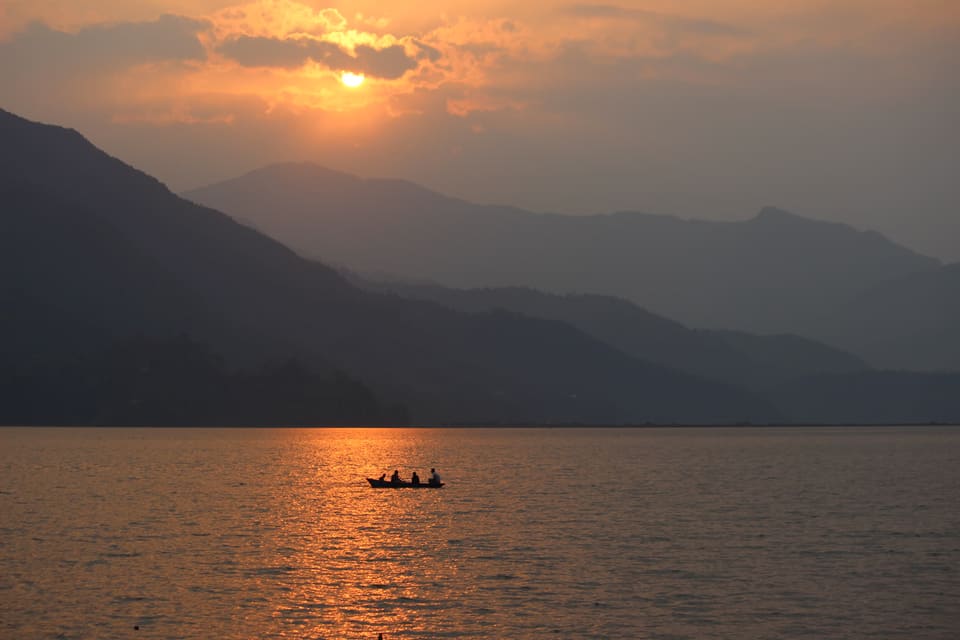
Evening in Pokhara: Lakeside's restaurants along Phewa Lake, the Annapurna range showing up behind the rooftops on clear evenings.
Days 5-6: Pokhara and the foothills
Give Pokhara two full days and choose its contents by energy. Day five: the early start to Sarangkot or a higher viewpoint for sunrise over Machhapuchhre and the Annapurnas; tandem paragliding from Sarangkot if that is your kind of thing — Pokhara is one of the world's established tandem centres and the morning flights run in season; the afternoon for the World Peace Pagoda, reached by boat across Phewa and a forest climb, with the best combined lake-and-mountain panorama in the country.
Day six: Phewa Lake by rowboat to the island temple, the International Mountain Museum for context on the eight-thousanders, and the caves and cafés of the lakeside strip. Or use the day for the thing Pokhara exists for: a short guided walk into the foothills — Australian Camp or the lower Mardi Himal trail — that samples the trekking without the multi-day commitment. Note that even a one-day walk now falls under the guide-and-TIMS rule on most listed routes; agencies in Lakeside arrange day guides cheaply.
If a trek day wins, build it as a real booking: the guide, the NPR 3,000 Annapurna Conservation Area entry and the NPR 2,000 TIMS card are the same paperwork a two-week Circuit walker buys, only bought for a day. The permits guide on this site walks through the stack; the difference is that your agency in Pokhara can process all of it inside 24 hours for the standard routes, whereas restricted-area paperwork needs days in Kathmandu.
Days 7-8: Chitwan
Road to the Terai: Pokhara to Sauraha, the village on the edge of Chitwan National Park, is four to five hours by tourist bus. Book a two-night safari package with a lodge before you arrive — package rates bundle the park entry (NPR 2,000 per person per day plus VAT, the official tariff), a naturalist guide and the activities: a walking safari with trackers in rhino country, a dugout canoe down the Rapti past gharial crocodiles, a jeep drive into the grassland, and a Tharu cultural evening. The rhinoceros encounters here are genuinely close; the tigers are genuinely invisible most visits.
Two nights is the right length — one turns the park into a checklist, three exceeds what the activities justify.
What the package should include, so you can compare lodge quotes properly: the NPR 2,000-a-day park entry plus VAT, all meals, the naturalist guide, and the standard activity set — walking safari, canoe, jeep drive and the Tharu evening. What varies enormously between lodges at the same headline price is the jeep-drive format (shared vehicle versus private) and the distance of the lodge from the park boundary, which decides how much of your two days is jungle and how much is road. Ask both questions before paying; the answers are worth more than a star rating.
Day 9: back to Kathmandu
The road home: Sauraha to Kathmandu is five to six hours by bus. A morning departure lands you in the capital mid-afternoon with time for a last evening in Thamel or Patan — the south side of the valley, with its cafés and workshops, is a gentler last night than the tourist strip. If the budget allows, the 25-minute flight back from Bharatpur (near Chitwan) converts the day into a half-day and buys a final mountain-flanked approach into the valley.
Day 10: the buffer
Deliberately empty. Use it for whatever the trip owes you: the sight you missed, the second visit to the square you loved, or the delay the weather inflicted earlier. If everything ran perfectly, it is a slow morning of last shopping and a temple you have already earned the right to revisit. Travellers who schedule an international flight on day nine instead learn why buffers matter: one fog-bound morning flight or one landslide-closed road and the connection is gone.
Health, altitude and what to book before you fly
Altitude is the least of this itinerary's health questions: nothing on the route sleeps high — Kathmandu sits at about 1,400 metres, Pokhara lower still, Chitwan in the low Terai — so acute mountain sickness is not part of this trip. The real list is ordinary: purified or filtered water rather than a fortnight of plastic bottles, sun protection that valley altitudes make genuinely necessary, and the standard travel-health conversation with your own clinic before departure. Travel insurance belongs in the booking pile, not the later pile — and read what it covers, because adventure activities such as paragliding are excluded from some policies by default.
A workable booking order, roughly a month out: international flights first; then the Chitwan lodge package, because good lodges fill first for the October-November window; then Pokhara flights or sofa bus seats if you are travelling in peak season; then any day-guide for the Pokhara foothills, which an agency in Lakeside can also arrange on arrival. The valley's monument gates need nothing booked in advance — cash in small rupee notes buys every entry, from the NPR 200 at Swayambhunath to the US$18 at Bhaktapur, and the NPR 1,000 tickets at Kathmandu, Patan and Pashupatinath.
What the ten days cost
On 2026 market rates, the mid-range version of this itinerary — en-suite rooms, sofa buses, a Chitwan package, gate fees, guided days — lands around US$60-100 per day per person, or roughly US$700-1,000 for the trip excluding international flights and visa (US$30-50). The backpacker version, on local buses and simple guesthouses with a day-trek instead of a package, runs US$30-45 per day. The big levers are the Pokhara flight (adds roughly US$90-180 over the bus, round trip) and the Chitwan lodge tier (a basic package versus a luxury jungle lodge can differ by a factor of four).
For the arithmetic behind those ranges: mid-range rooms run NPR 2,500-5,000 a night in the two hubs; tourist buses NPR 1,500-1,700 for the long legs; a Chitwan package bundles the NPR 2,000-a-day park entry (plus VAT), full board and activities; heavy sightseeing days in the valley accumulate NPR 2,000-3,000 of gate fees; and a guided day-walk from Pokhara adds a guide at US$25-35 a day on top of the NPR 5,000 of conservation paperwork. Each of those line items has its own story on this site — the Nepal travel cost guide for the daily budgets, the trekking permits guide for the paperwork, and the month-by-month guide for choosing the window.
Variations
Trade Chitwan for Lumbini if the Buddhist heritage pulls harder than the jungle — the road logistics are similar and the Maya Devi Temple and Monastic Zone deserve their overnight. Trade Pokhara's second day for a two-day Poon Hill sampler if you are fit and fast — but understand that a real Himalayan trek needs a week, not a slice. And in monsoon, keep the itinerary's bones but expect every road leg to stretch, and swap the mountain days for Bandipur, a preserved Newari hill town that wears rain well.
Sources: Nepal Tourism Board heritage-site entry fees and park entry fees tables (ntb.gov.np, fetched 1 November 2026). Bus fares from Nepali booking platforms (nepalvehiclerental.com, bussewa.com.np, 12go.asia) and flight fares from trip.com listings, retrieved 1 November 2026; journey times are realistic road estimates, not scheduled times.
From readers
Traveller experiences
Personal notes and ratings from readers who have been to Nepal.
Checking your session…
No experiences yet.
Sign in to be the first reader to describe this place.
Keep reading
Nepal in October: Weather, Festivals and the Start of Trekking Season
What Nepal is actually like in October — the monsoon's end, the clearest mountain air of the year, Dashain and Tihar, and the booking realities of the busiest month.
min read
Nepal Solo Travel: What Changes Now That the Famous Treks Require a Guide
A solo traveller's Nepal: what the 2023 guide rule means for trekking alone, where solo travel still works untouched, what it costs to travel alone, and the practical safety picture.
min read
Nepal Trekking Permits: What You Need and What They Cost
The three layers of Nepali trekking paperwork — park and conservation entry, the TIMS card, and restricted-area permits — what changed in 2023, what each one costs, and who issues them.
min read