
Jaipur and the Forts of Rajasthan: A Practical Guide from Amber to Ranthambore
The pink city, the hill forts that once defended it, and the desert most itineraries leave out.

Jaipur is worth more than a quick stop between Delhi and the desert. The old city is a working district, with markets, workshops, temples, guesthouses and government offices going about their business; it is not a preserved film set. Sawai Jai Singh II founded it in 1727, moving his capital from the older settlement at Amber. Jaipur City, Amber Fort and Nahargarh Fort were added to the UNESCO World Heritage List in 2013. The pink that made the city famous comes from local sandstone and lime, and it shifts with the paint, dust and light. Fort walls tend to be a dusty rose, gates a stronger red, with details picked out in blue, white or green.
For Jaipur alone, three full days is a sensible minimum. Amber takes half a day, City Palace and its gates another two hours, Hawa Mahal an hour, Jantar Mantar at least ninety minutes, and Nahargarh is best in the late afternoon. Bishnupur and Ranthambore are not day trips from Jaipur in any comfortable sense. A desert trip adds at least two days, and often more once the transfer to Jaisalmer is counted. Build the plan around early starts, one major site per half-day, and enough slack to sit out the traffic.
Amber Fort and the road to Sheesh Mahal
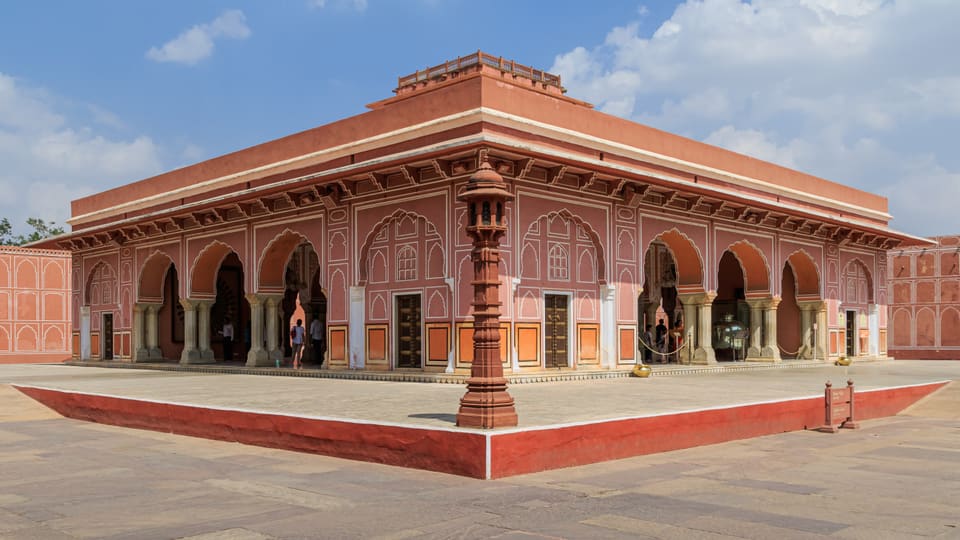
Amber, officially Amer these days, sits about 11 kilometres north of the city centre. A taxi or hired car takes 25 to 45 minutes, depending on which road out of Jaipur you use. Shared autos and local buses cost far less, though you still have to walk the last stretch from the parking area. Arrive for opening, around 9 a.m. in winter or 8 a.m. from March onward. The fort is exposed sandstone, and shade runs out once the sun reaches the upper courtyards.
You enter through the Jaleb Chowk, a wide courtyard with four large water urns. Ganesh Pol comes first, then Hathi Pol, named for the elephant sculptures around its arch. Kesar Kyari, the saffron lake, is the garden where Akbar met the Amber ruler Prithvi Singh. Further in, the Shekhawati Pol, usually called the Mughal Gate, marks the shift into the palace's formal Mughal-style residential and ceremonial rooms. Treat them as a sequence rather than separate photo stops. Following the order explains how the fort grew from a Rajput stronghold into a court shaped by Mughal visitors.
“Most people give Amber two hours. Give it half a day, start at opening, and carry water. The fort is not difficult; the heat and the climb make it difficult.” Jaipur-based heritage guide Meena Singh said this while checking a group’s water bottles at the first chowk.
The Sheesh Mahal, or Palace of Mirrors, was built under Raja Man Singh I in the late sixteenth century. Small pieces of mirror glass, hundreds of them, cover the walls and ceiling. Oil lamps once threw light into those fragments, and a large hanging lamp still sits near the middle of the room. The well-known story puts the queen in an inner chamber, watching the reflections from behind a screen. That scene may or may not have happened as described, but the room is built to multiply light, and it still does when the lamps are lit. The floor and lower walls get crowded, so come early or late if you want space to look up.
Maota Lake lies below the fort, a wide blue-grey sheet of water against the dry Aravalli hills. The clearest view is from the upper galleries. It was built as a reservoir for the palace complex, not as a scenic lake in the modern sense. Boating at the foot has come and gone over the years, thanks to silting and changing operating arrangements, so don't plan the visit around it. On a cool day Amber is worth three hours; closer to five once you add the climbing, the photography and the walk down from the higher gates.
City Palace, its gates and the trading streets
City Palace is a royal complex that still functions as one, not a single museum room. Jai Singh II started it in 1727, and later rulers added the Chandra Mahal, Mubarak Mahal, Diwan-i-Aam, Diwan-i-Khas and residential ranges. Give it about two hours if the galleries are open. The public route can change, and you may enter through Pritam Pol even though the walk takes in several ceremonial gates. Photography rules differ from one section to the next, so read the signs instead of assuming every courtyard is fair game.
The four main gates are Dhwaj Darwaza, Tripolia Darwaza, Mubarak Darwaza and Laxmi Pol. Dhwaj Darwaza serves as the formal entrance for official arrivals. Tripolia Darwaza is the tall, three-level gate with several openings. Mubarak Darwaza gave a route toward Jal Mahal and the royal women's quarters by the water, and Laxmi Pol belongs to the more private side of the palace. They repay a closer look for what they say about rank, movement and controlled access, not just as four impressive doors.
Four old trading streets around the palace still carry names that describe what was sold there. Johari Bazaar deals in jewellery, Bapu Bazaar in cloth, Tripolia Bazaar in painted goods and handicrafts, Chandpole in brass and other metalware. Quality and prices vary, and some stretches now sell phone covers and imported gifts next to the traditional stock. Walk the lanes in the morning, before shopkeepers set out their best displays, then head back to Johari Bazaar if you want to compare silver, meenakari and loose gemstones. Settle the price before asking for a detailed explanation of how a stone is set.
Hawa Mahal and the women behind the windows
Hawa Mahal was built in 1799 by Sawai Pratap Singh as an extension of the royal women's quarters. The building rises about five storeys, roughly 15 metres above the street. Guidebooks like a round number and often call the facade one of five hundred windows. The official count is 953 small jharokhas, so nearer a thousand. Larger arches sit at the lower level, while the upper front is a dense honeycomb of screened openings. The screen is the point: windows that let in air and light while letting the women inside look out without being seen.
Cooling the whole city was never the point. Women of the royal household used the upper chambers to watch street festivals, processions and arrivals, kept behind a screen in keeping with purdah. The name means air, and the windows do create a draught, but this unusual facade was built for watching without being watched. You enter from the rear, up narrow stairs from a crowded lane, and the rooftop gives a good view over the old city. Midday is hot and busy. Come near opening for the interior, then take your photograph of the pink street facade from across the road.
Jantar Mantar and the sundial that still works
Jantar Mantar is the largest and best preserved of the five observatories of that name still standing in India. Sawai Jai Singh II built it between 1728 and 1734, while Jaipur was being laid out as a new capital. Its fourteen large instruments were made for practical astronomy, not ornament. The best known is the Vrihat Samrat Yantra, usually called the world's largest stone sundial. The triangular wall stands about 27.4 metres high and 44.8 metres long.
The sundial works because its triangular gnomon points north and south, its edge aligned with the sun's path. At local solar noon the shadow lies along the central north-south line. At other hours it crosses graduated scales that give local apparent solar time. The shadow moves at roughly one millimetre per second, so if you see it shift, that is not your eyes playing up. The other instruments measure solar declination, altitude, azimuth and latitude. Readings may differ a little from a wristwatch, since a sundial follows the sun and not official time zones. Go between 8 and 10:30 a.m. Shade is scarce and the metal surfaces get hot.
Bishnupur, the terracotta town beyond Rajasthan
Bishnupur sometimes gets tacked onto a Rajasthan itinerary as if it were an hour from Jaipur. It isn't. The town sits in Bankura district in West Bengal, about 160 kilometres away, and a sensible road journey takes two hours 45 minutes to three and a half hours. It became a UNESCO site in 2016 and gets far fewer visitors than Jaipur, Amber or Ranthambore. Its appeal is narrow and specific: a compact group of temples built almost entirely from fired terracotta rather than carved stone.
The three most rewarding temples are Shyam Rai, Jore Bangla and Madanmohan. Shyam Rai, built in 1643, rises about 21 metres and follows the model of the Radha-Govinda temple at Vrindavan. Smaller pinnacles cluster around its tall central spire, and terracotta panels show figures and plants. Jore Bangla, finished in 1655, takes its name, the double house, from an unusual double-pitched roof. Madanmohan, finished in 1694, is a more restrained ekaratna form with rows of terracotta plaques. The carving is weathered and the reddish surfaces differ from one temple to the next. A short-to-medium lens will serve you better here than a wide-angle.
Give it a full day and leave Jaipur around 5:30 a.m. The ASI site charges one combined ticket for the main monuments, and there is no need to rush through them all. Carry water and snacks, as food options near the archaeological museum are limited. A car and driver for a Jaipur-Bishnupur day costs roughly ₹8,000 to ₹12,000, depending on the vehicle, fuel, tolls and waiting time. Confirm the total before you set off. If you have three days in Jaipur, Bishnupur should take the place of a slower city day, not be added on top of one.
Nahargarh and the trouble after sunset
Jai Singh II began Nahargarh in 1734 as a defensive stronghold on the ridge above Jaipur. The centre is only six kilometres away, but traffic can stretch that into a 45-minute drive. The fort is best known for the view south and west over the city. In winter, aim for around 4 p.m.; at other times, arrive 30 to 45 minutes before sunset. From the upper terrace you can pick out the palace compounds, the street grid and the edge of the Aravalli hills, though haze after a hot day can blur the detail.
The summit road is steep, rough and narrow, and vehicles squeeze past pedestrians. Lighting is poor on some sections after sunset. Don't plan to walk down in the dark unless you know the route, and don't drive up after dark if the hill is new to you. Monkeys are the bigger problem. The warning is literal: a careless visitor is more likely to lose a camera or a phone than any food. These animals work around cars and open bags, snatch shiny objects and tug at straps. Keep devices in a closed bag, don't tease a monkey with a lens or a phone, and don't try to wrestle one for a device. Call a guard or guide instead.
Ranthambore and the difficult tiger question
Ranthambore sits about 180 kilometres from Jaipur. By road it takes roughly three to three and a half hours; trains from Jaipur to Sawai Madhopur usually run two hours 45 minutes to three hours 15 minutes. The reserve has been part of Project Tiger since 1973. Dry deciduous forest, lakes, ruined chhatris and broad roads here support birds and large mammals as well as tigers. The park is split into ten safari zones. A permit names a zone and a time, and the zone can change at short notice because of tracking, weather, animal movement or conservation work.
Ranthambore is harder work than Chitwan. A morning drive may give you a distant pair of tracks, an alarm call with nothing in sight, or no tiger at all. Jeeps are packed, the forest is hard to read, and animals often stay in the scrub. Chitwan usually offers a first-time visitor better odds, because open grassland, riverine forest and plenty of animal movement make sightings easier. If a tiger is your only objective, Chitwan is the sounder bet.
For a traveller who can sit through failures, Ranthambore gives more back. The Aravalli landscape is less manicured, the ruins add historical context, and a substantial cat sighting is possible without the constant procession of vehicles you get in busier parks. It is also harder to fake a result with a long lens. Stay at least three nights, four if you can. Book morning and afternoon safaris, keep the same hotel, and take the permit you are given. Ask for zones 2 to 5 where there is a choice, as they have a useful record with big cats, but no zone takes the luck out of it.
How long to stay in Jaipur
Three nights gives you three full days in Jaipur, or you can arrive early and leave after the third evening. A workable first day starts at Amber around 8 or 9 a.m., takes in lunch in the old city, and ends at City Palace in the late afternoon. On day two, see Hawa Mahal at opening, Jantar Mantar before noon and Nahargarh for the late-afternoon light. Keep the third day for City Palace if you missed it, plus the bazaars, Albert Hall and a slower meal. Trying to fit Amber, City Palace, Hawa Mahal and Jantar Mantar into one day ends in a tired walk and poor photographs.
From Jaipur, Bishnupur needs a third day given over to it. Ranthambore needs at least three nights of park access and belongs to a separate part of the trip. The familiar formula of three days in Jaipur plus two for the desert is a minimum, not a comfortable desert tour. Jaipur to Jaisalmer runs around seven to nine hours by road, or roughly six to seven hours by train. The Sam dunes are another 40 kilometres from Jaisalmer, then 15 to 20 kilometres of rough access road. Two extra days leaves little room for delays, so add a night if the Jaisalmer and Sam combination matters to you.
When to go and what the traffic does
The best season runs from October to March. October and November are warm but usually manageable. December and January bring cold mornings, often around 5 to 10 degrees Celsius, and bright afternoons. February and March stay dry and grow steadily hotter. May and June regularly hit 40 to 45 degrees Celsius; Amber's exposed courtyards and Nahargarh's summit become genuinely difficult places to visit, and a local guide is worth more than a camera. The July to September monsoon brings heavy rain, high humidity, waterlogged roads and fewer visitors, though the city stays open.
Check festival and wedding dates before you book. Diwali, major local fairs and a large wedding can push hotel prices up by 30 to 80 percent, close roads and fill restaurants. Winter fog can delay trains around Delhi and northern Rajasthan too. Take a light jacket for dawn safaris and fort visits, even when the afternoon reaches the high 20s.
Traffic is the main reason a short journey can take an hour. The walled city runs on one-way roads, restricted entry points and temporary block schemes for processions, market days, VIP movements and security operations. A closure can appear with little warning, and a map may send you toward a gate that has just been shut. Allow an extra 30 to 60 minutes for a palace, bazaar or fort visit, and don't book a train connection on the strength of the shortest possible road journey. Take a metered auto or an app-based taxi where you can. Renting a scooter is a bad idea on a first visit, since lane directions, parking and monkeys all add risk.
Trains, road transfers and tickets
Delhi to Jaipur takes about five hours by train. Several services on the Delhi-Kota route cover it, the fastest in roughly four and a half hours, others closer to five and a half. Take a chair car or sleeper rather than an unreserved coach if you want luggage space and to arrive in decent shape. Jaipur Junction is the main station in the old city; Jaipur Gandhinagar is farther north. The airport is about 15 kilometres from the centre, a run of 30 to 50 minutes and considerably longer in traffic.
Local buses, shared autos or a taxi all make Amber easy. A taxi from the railway station or the walled city should cost roughly ₹250 to ₹450, so agree the fare before leaving. For Nahargarh, sharing is cheaper, but the wait can take longer than the 6-kilometre distance suggests. Trains from Jaipur to Sawai Madhopur are frequent, though check with the forest department and your hotel about the current transfer plan. A private car for Ranthambore costs roughly ₹7,000 to ₹12,000 each way before accommodation, depending on the vehicle and tolls.
The main monuments sell tickets separately, and there is also a combined Rajasthan tourist circuit pass. The pass can help when a route covers several sites, but its price, validity and list of monuments keep changing, so check it against the current Rajasthan Tourism and Archaeology Department tariff before buying. Ranthambore comes under the forest department and is normally charged apart from city monument tickets. Use the official online portals for Ranthambore permits, and steer clear of agents promising a “guaranteed” tiger or a zone they cannot book.
Recent official rates have been around ₹25 for an Indian visitor and ₹300 for a foreign visitor at Amber; ₹100 and ₹700 at City Palace; ₹50 and ₹150 at Hawa Mahal; ₹50 and ₹150 at Jantar Mantar; and ₹100 and ₹300 at Nahargarh. Bishnupur is about ₹20 for Indian visitors and ₹250 for foreign visitors. Paying separately at the five Jaipur sites comes to about ₹325 for an Indian visitor and ₹1,600 for a foreign visitor before camera charges. Some sites charge photo fees of ₹50 to ₹100. Rates can change, so carry a little cash and check the posted price when you arrive.
Sleeping in a haveli and eating in the walled city
Stay inside the walled city if you can. Dag Ka Rasta, Bapu Bazaar, Sansar Marg and the lanes around City Palace put the major sights within reach of an evening walk. Kanda Haveli near Dag Ka Rasta and Jaipur Haveli near Choti Chaupar are well-established converted havelis. Smaller guesthouses around Bapu Bazaar cost less, but soundproofing and hot water are more of a lottery. Expect roughly ₹800 to ₹1,500 for a simple room, about ₹1,800 to ₹3,500 for a well-run midrange haveli, and from about ₹4,000 to ₹8,000 or more before tax for a full heritage property with more service. Festival rates can be much higher.
Ask whether the room has air conditioning, an inner courtyard or a street-facing window. Old havelis have thick walls that help in the heat, but they also mean stairs, hard floors and noise carrying through the building. A rooftop room is not automatically the quiet one. Taxis may not be able to get into the narrow lane outside, so ask the haveli which gate to use and where to meet. Three nights gives you a settled base for three full days. One night here and a hotel move there saves little once check-in, luggage transfer and traffic are counted.
For straightforward Rajasthani food, Laxmi Misthan Bhandar near MI Road and Badi Chaupar is convenient, busy and cheap by western standards. A pyaaz kachori costs about ₹40 to ₹80, a dal baati churma thali around ₹250 to ₹450, and most drinks fall between ₹50 and ₹150. Restaurants on MI Road do more vegetarian dishes, while roadside tapris can fill you up for ₹100 to ₹250. Tea usually comes in at ₹20 to ₹50 and a bottle of water about ₹20 to ₹40. Johari Bazaar and rooftop places charge tourist prices. Check the bill for service charges, and don't pay for a welcome drink or folk performance you never asked for.
The monkey warning and other things not to ignore


Jaipur and the Forts of Rajasthan, India
Be specific about the warning. At Amber, monkeys near the entrance and food stalls have taken phones, glasses and small bags. At Nahargarh they work around parked cars and the summit road. A shiny device or loose strap often interests them more than food, which makes a camera hanging from your neck an easy target. Put cameras and phones in a zipped bag, keep food out of sight, never offer either to an animal and don't walk up to one holding a tablet. If something is taken, find a guard or guide. Don't chase the monkey or grab at it; that only raises the chance of injury and a scramble.
Don't assume a drone is allowed. Amber and other protected monuments enforce strict security rules, and permission may be refused even after you have paid the normal entrance fee. At temples, wear clothes that cover shoulders and knees, take off your shoes where the signs ask, and carry a bottle you can refill. Palace floors, bazaars and fort steps are hard on shoes that can't cope with broken stone and steep descents.
Stick to official taxis, metered rickshaws or established ride-hailing apps instead of following a tout who tells you the usual route is closed. Don't change money in a side lane, and don't take a free “fort closure” story at face value without checking the posted notice. At Ranthambore, stay in the safari vehicle except where the guide says otherwise, keep quiet when an animal is close, and don't pressure the driver to chase or block it. A calm sighting beats a damaged vehicle or an angry guide.
Jaipur works well when the plan respects distance and heat. Give the first day to Amber, the second to the old city and Nahargarh, and keep a third for the monuments you didn't finish. Add Bishnupur only as a full day, Ranthambore for several nights, and at least two days for the desert. Start early, carry water, keep your phone away from the monkeys and allow for the traffic. That is enough to see the forts properly without turning the trip into a race between them.
From readers
Traveller experiences
Personal notes and ratings from readers who have been to Jaipur and the Forts of Rajasthan.
Checking your session…
No experiences yet.
Sign in to be the first reader to describe this place.
Keep reading
More stories from this collection are coming.