
Varanasi and the Ganges: a practical guide to the ghats
The city most often called the world's oldest continuously inhabited one, and what four in the morning on a ghat really looks like: working boats, wood smoke, open drains.

The ghats: where the Ganges is actually used
Varanasi is often called the world's oldest continuously inhabited city. Nobody can prove that outright, but what matters is that this is a working city built around a river, not a museum. The Ganges forms the western edge of the old city at 25.3176, 82.9739, and its ghats are used for bathing, worship, transport, commerce and cremation, often within a few hundred metres of each other.
About 80 ghats cover roughly 7 km of riverfront, and most visitors stay between Assi Ghat and Dashashwamedh Ghat. That stretch is the easiest part of the city to reach on foot, and the easiest place to find a boat, an autorickshaw, food or a hotel room with a river view. It is also the busiest and most commercial. At sunset, particularly in festival season, people pack several ghat steps at a time.
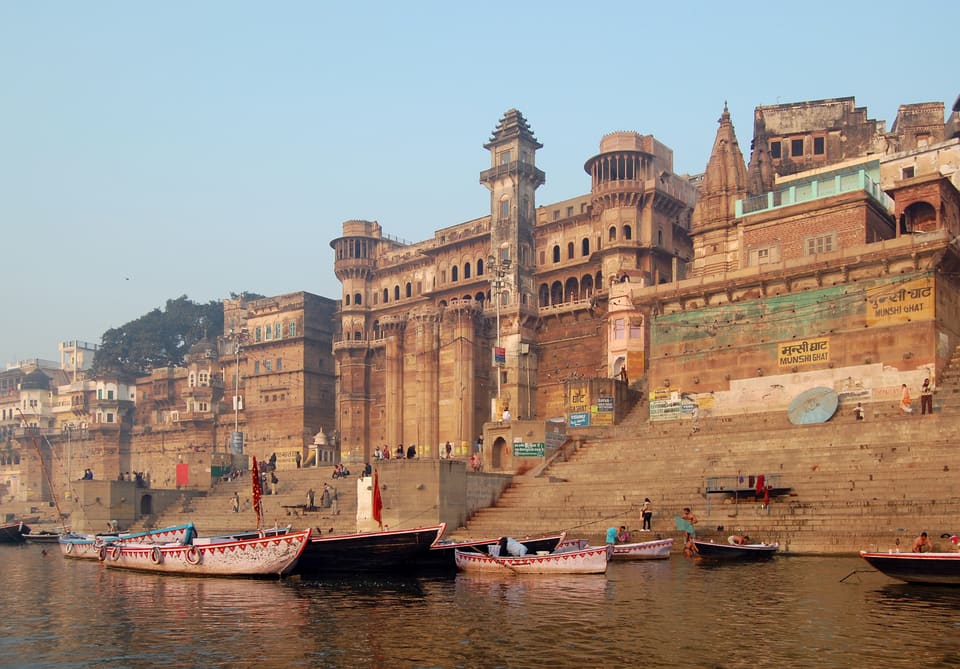
Dashashwamedh is where the famous evening Ganga aarti takes place. It usually starts near sunset and runs 45 to 60 minutes, though the exact time shifts through the year. Entering the riverfront costs nothing and watching the aarti is free, so there is no ticket to buy. Get there 45 to 60 minutes early if you want a spot near the main platform; otherwise stand further back along the steps, where the view is less obstructed.
Dashashwamedh is not where you learn what Varanasi is like at four in the morning. By then the food stalls and souvenir shops are shut, most of the traffic has gone, and the ghat belongs again to residents, priests, boat crews and early workers. For an early start, try Tulsi Ghat, also called Man Mandir Ghat, Kedar Ghat, Assi Ghat or one of the quieter ghats to the north. Each one has its own working rhythm.
At four, the stone steps are damp and uneven in places. Boat crews check ropes, fuel and pumps, and flower sellers begin arriving around 4:30. Milkmen move along the upper road, men get ready for a bath, and pilgrims stop at small riverside shrines. Aarti teams test loudspeakers and lights. From Manikarnika the smell of wood smoke and the sound of chanting can carry across the water. It is busy, damp and sometimes dirty, and nothing like a quiet breakfast by the river.
The first tourist boats tend to leave around 5:30 or 6, depending on the season and the river level. A shared trip of 30 to 45 minutes commonly costs ₹100 to ₹200 per person, while a private boat for 45 to 60 minutes usually runs ₹400 to ₹800, and more in February and March. Settle the route, duration and price before you step aboard. If someone promises sunrise or a free hotel pickup, get the total in advance rather than accepting a vague offer.
At four in the morning the river is not quiet. It is working.
That comes from Nahar Singh, a Ganges boat pilot who has worked the old ghats for 18 years. He knows which crews leave early, which landing steps turn slippery and which sunset operators add an unscheduled stop to earn a shop commission. His advice is straightforward: pick your boatman before dawn, pay the agreed amount, and keep your phone away from the water.
Manikarnika: cremation without spectacle
Manikarnika is the best-known wood-fired cremation ground in Varanasi. Bodies arrive day and night on bamboo biers, with relatives, priests and workers alongside. The fire never really goes out, and the smell of burning wood and organic material is strong. This is a place of mourning that happens to be working while you are there, not a performance staged for visitors.
You can watch from the public steps above and beside the cremation area, as long as staff have not closed a section for a family rite. Keep a respectful distance. Never stand between relatives and the pyre, touch the wood, step over offerings or touch a body, and do not speak to mourners unless someone speaks to you first. Crowding around a private cremation is not acceptable.
Do not photograph the cremation, and that includes bodies, shrouds, pyres, workers carrying biers and grieving relatives. Do not ask a worker to pose, do not fly a drone and do not take a selfie with the fire behind you. That other tourists photograph it, or that it is secretly allowed, is not a reason to do it yourself.
Smoke can travel hundreds of metres, especially early in the morning when the air is still. If you have asthma or react strongly to smoke, go during daylight, watch which way the wind is blowing and stay away from the lower platform. Varanasi has also added electric cremation at the Swarn Shramik Van facility on the Assi side. Access, opening hours and fees change, so ask your hotel or a municipal information centre instead of turning up without checking.
Kashi Vishwanath: four rebuilds and a long queue
Kashi Vishwanath Temple has been rebuilt four times. The present complex is mostly linked to the late 18th-century rebuilding led by Rani Ahilyabai Holkar, with later additions and repairs after that. The site is active from before sunrise until late evening, and ordinary darshan is free. The hard part is getting through security and the queue.
On a normal weekday, arriving between 5 and 6 in the morning may mean a wait of roughly 45 to 90 minutes. By 8, and especially during a festival, that can stretch to two to four hours. Security screening, bag checks and identity checks come before the main queue, and foreign visitors should carry their original passport because it may be asked for. After screening there is a second, separate line for darshan.
The paid Bhoga aarti, usually held around 3:30 in the morning, is separate from ordinary free entry. It has commonly cost about ₹125 per person, and reserving online in advance is the easiest way in. Arrangements and prices can change, so check the temple's current information. Anyone who offers a special darshan for a large cash payment outside the official system is a tout, not a priest.
Wear clothes that cover your shoulders and knees, take your shoes off when directed and expect to hand in large bags. Cameras and phones may be restricted inside, so follow the signs at each checkpoint. Keep small notes and a banknote for the shoe area, since card and mobile payment do not always work. The queue is hot, slow and orderly, and a bottle of water and a hat will help you more than an expensive guide.
Saraswati Ghats and Tulsi at dawn
The river aarti at first light happens at two nearby locations. Saraswati Ghat has a smaller morning ceremony on a platform set in the river, while Tulsi Ghat, also called Man Mandir Ghat, draws the larger and better-known dawn gathering. Drivers and hotel staff sometimes use the names loosely, so say which one you want and check the access point before you set off.
It begins about 30 minutes before sunrise, which falls roughly at 5:30 in March and close to 7 in January. Priests chant beside a small fire, with bells, conch shells and incense. Loudspeakers carry the sound across the water. From the steps the platform looks close, but the current, boat traffic and a pontoon that shifts position can make the access point confusing, so ask a local boatman or priest where the ceremony is being held that morning.
Arrive 30 minutes early, stand above the working boat landing and keep the ramps clear. Morning bathing carries on around the aarti, including at the less formal edges of the ghat. A private boat is more comfortable than trying to get off a crowded public boat at sunrise, but it is not essential. You do not need to give a donation to watch, and anyone taking close photographs should ask first.
Behind the ghats: silk, kabirs and working lanes
The lanes behind Dashashwamedh, Tulsi, Bhairav and Chauk are narrow, dark after sunset and easy to get lost in. They hold weaving rooms, small guesthouses, vegetable carts, repair shops, printers and family businesses. Many shops close by 8 or 9 in the morning. Walk early, drop a pin on your map and expect much of the route to be stairs rather than road.
The kabirs are Muslim artisan families from Varanasi's long-established weaving community. In this context, kabir names a community and an occupation, not the devotional poet Kabir. Their workshops sit around the old weaving quarters, often in shared family rooms with narrow handlooms. They may be working in katan silk, organza, tanchoi, tussar or cloth made from recycled silk waste, and much of the work is done on contract for wholesalers rather than for walk-in shoppers.
The Weavers' House, or Kachi Ghar, near Tulsi Ghat is the clearest place to see how the trade is organised. It works with weaving families and sells straight to visitors. A simple silk stole may cost ₹1,500 to ₹4,000, a katan sari can run from about ₹8,000 to ₹30,000, and handloom pieces with substantial zari cost considerably more. Ask where the cloth was woven, because not everything sold as Banarasi was made in Varanasi.
Do not walk into a private workshop just because the door is open. Photograph the cloth rather than the weavers' faces unless they agree to it. If you buy from a shop rather than the cooperative, ask about the type of silk, the zari, dimensions, return policy and whether the item is handmade. A polite negotiation of 10 to 20 per cent may be possible, but there is no honest fixed discount, and many prices already include the salesroom overhead.
Sarnath: the Buddha's first sermon, about 30 km round trip
Sarnath is roughly 18 to 20 km northeast of central Varanasi by the direct road, so count on about 30 km for the round trip. Tradition identifies this area, specifically the Deer Park or Mrigadava, as the place where the Buddha gave his first sermon after enlightenment. The exact spot of the sermon has not survived as a single marked platform.
The main sites are the Dhamek Stupa, built by Ashoka to commemorate the sermon, the ruins of Mulagandhakuti Monastery and the Ashokan pillar. The original Lion Capital, about 3.1 metres high, is in the Sarnath Archaeological Museum, and a replica stands above Dhamek Stupa. Entry to the Archaeological Museum and the protected site generally costs about ₹20 for Indian adults and ₹500 for foreign adults, though it is worth checking the exact ticket combination at the gate.
The museum generally closes around 5, and Monday closures can affect either the museum or the protected area, so check before you travel. The easiest option is the train from Varanasi Junction, which takes about 15 to 25 minutes and usually costs ₹20 to ₹50. A taxi takes 45 to 60 minutes through traffic and costs roughly ₹500 to ₹700 one way. Buses are cheaper, often ₹50 to ₹150, but the wait can make them slower.
Ramnagar Fort and Man Mandir Ghat
Ramnagar Fort was built in 1734 and 1735 by Raja Man Singh I of the Kachhwaha Rajput dynasty. Inside is the Ramnagar Fort Museum, established in 1875 and described as one of India's oldest museums. Its collection covers the court's weapons, armour, paintings and textiles, along with everyday objects rather than only items used in royal ceremony.
The museum is usually open from 10 in the morning to 5 in the afternoon and shut on Mondays. Admission is commonly ₹50 for Indian adults and ₹500 for foreign adults. Carry identification, check the ticket counter for photography restrictions, and do not plan only a quick stop if you want time to read the displays. The fort itself is quieter than the main tourist ghats.
Man Mandir Ghat and Tulsi Ghat sit at the same northern end of the old-city waterfront, directly opposite the fort. They mark the practical end of the main ghat walk, not the end of the Ganges, which carries on for more than 2,000 km. A privately hired boat from Dashashwamedh reaches the area in 15 to 20 minutes for about ₹300 to ₹600, while walking takes roughly 30 to 40 minutes through the lanes.
A workable two-day plan
Allow two full days and one night on the riverfront. On day one, take a boat at 5:15, watch the morning aarti at Saraswati or Tulsi, eat breakfast by 7 and be in the Kashi Vishwanath queue before 7:30. After the temple, visit the old lanes and Kachi Ghar, have lunch around 1 and see Manikarnika in daylight. Rest through the hottest part of the afternoon, then head back to Dashashwamedh 45 minutes before sunset for the evening aarti.
On day two, leave for Sarnath by 8 and be back by 11:30. Have lunch, then visit Ramnagar Fort and Museum in the early afternoon. Finish at Tulsi and Man Mandir Ghat, where the river is quieter than at Dashashwamedh. If your morning boat ride was cancelled, take it here instead. The plan leaves room for delays without turning every attraction into a rushed stop.
Spend the night near Tulsi or Assi so you can use the river at both ends of the day. Overnight sleeping berths on boats are not a normal or comfortable way to visit Varanasi, although private late-afternoon and pre-dawn charters are available. If you want to be on the water at night, agree the route, lighting, duration and total price before you leave. A room on the ghat is usually the better place to sleep.
October to March is the practical season. October and November are generally easier than February and March, which bring festival programmes, bigger crowds and higher room rates, and Holi also has a major effect on prices and transport. April gets progressively hotter, and May or June can exceed 40 degrees Celsius. The monsoon, from late June through September, brings waterlogged lanes, slippery steps, water hyacinth in some drains and the occasional closure of low sections.
What everything costs
Varanasi's main ghat entrances and the evening Ganga aarti are free. Ordinary darshan at Kashi Vishwanath is free too, while the pre-dawn Bhoga aarti normally costs about ₹125. At Sarnath, the Archaeological Museum and site are about ₹20 for Indian adults and ₹500 for foreign adults, and Ramnagar Fort Museum charges about ₹50 for Indian adults and ₹500 for foreign adults. Rates change, so treat these as planning figures rather than fixed quotations.
A shared river boat commonly costs ₹100 to ₹200 per person for 30 to 45 minutes, and a private boat for one or two hours usually runs ₹400 to ₹800. Operators charge more in festival season. An autorickshaw within the old city is usually about ₹30 to ₹80, while a taxi costs around ₹150 to ₹350 for a standard cross-city trip. From the airport to the old city, expect roughly ₹500 to ₹800, depending on traffic and the exact ghat.
A simple vegetarian thali or local meal costs about ₹150 to ₹300. Breakfast often comes to ₹30 to ₹100, tea is around ₹20 to ₹60 and bottled water usually ₹20 to ₹40. A rooftop restaurant dinner with a view can cost ₹400 to ₹900. A private guide for half a day is commonly ₹500 to ₹1,000, though a hotel-arranged guide may charge more and a tout may quote less for the wrong reasons.
Budget hotels and guesthouses start around ₹1,000 to ₹3,000 a night in ordinary months. A room directly on Assi or Tulsi, or in a heritage property on the ghats, can cost ₹3,500 to ₹10,000. During major festivals prices can double or triple, and the best river-facing rooms go first. Small change, a few banknotes and reliable mobile data are more useful than a lot of cash.
Pollution, the aghast, shoes and ghat conduct
The Ganges is heavily polluted. The water is brown or green, drain outlets carry wastewater, and foam and rubbish collect near some ghats. Clean-up projects have improved parts of the city, but the water is still not safe for swimming or immersion. Do not put your head under, do not wash with it and do not let children play in it. If you want time on the river, take a boat.
The aghast, the cremation fire at Manikarnika, is physically the hardest part of the visit. Up close, the heat, smoke, ash and smell are hard to ignore, and the still morning air can make the smoke linger. A mask helps with dust but will not remove gases or odours. If you are sensitive to smoke, keep your visit short and stay on the upper steps, where there is more ventilation.
Shoes are not normally removed on an open riverside ghat, but they have to come off at the temple, small shrines, some homes and anywhere a guard or host asks. Take them off without arguing, and carry socks if you dislike walking barefoot on hot stone. Keep socks and shoes together in a bag. At a ghat, do not walk on cooking areas, prayer mats, bathing places or funeral platforms.
Most residents and religious authorities treat Varanasi as a vegetarian city. Restaurants and guesthouses mostly serve no meat, fish, eggs or alcohol, and many have never handled them. Do not bring meat or alcohol to the ghats or into the old lanes. If you do not eat vegetarian food, tell your accommodation before booking, but do not expect a standard restaurant to rework its kitchen when you arrive.
Dress modestly. Men should avoid sleeveless shirts and very short shorts, and women should cover their shoulders and knees, with a scarf or shawl for small shrines. Do not touch a ritual object, bathe beside a worshipper, feed a monkey, throw coins or plastic into the river, fly a drone without permission or speak loudly during a ceremony. Ask before photographing anyone, and keep your voice low while walking through the residential lanes.
Where to sleep and eat
Stay on the ghats if you can afford it. Tulsi Ghat is the quieter choice and gives the best access to Man Mandir and Ramnagar. Assi Ghat has more guesthouses, simple restaurants and transport connections. Dashashwamedh is convenient for the evening aarti, but it can be noisy, crowded and surrounded by persistent touts. A room near Manikarnika is a poor choice for light sleepers, given the cremation work and late-night activity.
Inspect the actual room before paying a festival premium. Many heritage properties have steep stairs, no lift, thin walls, old plumbing and unreliable hot water. Check the air conditioning or fans, window locks, mosquito screens, mobile-data coverage and the route from the entrance after dark. Photographs can be old or taken of a different room, so ask for a recent image of the exact room and the nearest public ghat.
For straightforward vegetarian food, look for a local thali restaurant around Assi or Dashashwamedh. The Weavers' Cafe near Tulsi Ghat is useful for a simple meal, and several guesthouses around Tulsi and Assi serve rooftop dinners. Order a thali, kachori, samosa, chaat, litti chokha or dal rather than paying for a river view alone. Avoid any restaurant that appears only after a tout offers you free food or an unexpected special puja.
Getting there and getting around
The long train from Delhi is the usual overland option. Trains to Varanasi Junction or Varanasi Cantt take roughly 13 to 20 hours, with fares from about ₹700 to ₹1,800 depending on class and route. A few services carry on to Pt Deen Dayal Upadhyay Junction, 10 km or so further out, so check the final destination instead of assuming every train reaches BSB. If a long shared sleeping compartment bothers you, book a lower berth.
Flights from Delhi to Lal Bahadur Shastri Airport usually take 1 hour 20 minutes to 1 hour 40 minutes and commonly cost ₹6,000 to ₹12,000. The airport is 25 to 35 minutes from the old city when traffic is reasonable, and longer at peak hours. Use a prepaid taxi counter or an app-based car. An autorickshaw is cheaper but awkward with luggage. Many travellers combine a flight with a train, travelling to Varanasi overnight to cut hotel costs.
Most of the old city cannot be reached by car. From Varanasi Junction, an autorickshaw to a ghat usually costs ₹30 to ₹80, and a taxi about ₹150 to ₹250. Hotel staff can call a taxi to meet you at the station, which is sensible after a night train. For Sarnath, take the train where possible. Agree taxi fares before the journey, especially for the airport, Sarnath or Ramnagar, and confirm whether the driver is using a meter.
Warnings worth reading
Do not swim in the Ganges. Untreated sewage, industrial waste and other contaminants enter the river, and the current near the steps can be strong, particularly after rain or during release flows. Swimming is not something locals do on these ghats. A boat ride is the sensible way to be on the water, and even then keep your head, feet and any open wound out of it.


Varanasi and the Ganges, India
Do not photograph the cremation at Manikarnika. Artistic images, selfies, drone footage and a local guide's assurance are all no exception. The bodies and pyres belong to people dealing with a death in the family. Being an outsider makes restraint more important, not less.
Do not hand your passport to a tout, and do not let anyone lead you to a private shop, priest, boat or hotel without a written price and a receipt. The standard scam works like this: a cheap special darshan is offered, a compulsory donation is added, and then a commission is earned from a shop or boat. Use official counters, ask your hotel to arrange a guide, and check the final bill before paying anything beyond the stated fare.
Keep food and loose bags away from monkeys. They can grab phones, bottles and paper, and anything taken up to a roof is not easy to get back, so do not feed them. Use a zipped bag, carry as few valuables as possible and do not leave a rickshaw or train compartment unattended, even for a minute. In the monsoon, water can get into low-lying rooms, so ask a hotel how it handles flooding before booking.
Varanasi is not a smooth tourist operation. It is crowded, uneven, polluted in places and often overpriced if you arrive without a plan. Two days, one night on the riverfront and a willingness to accept the cremation smoke, the bad smells and the living religious customs will get you further than a rushed one-day checklist. Respect the restrictions, agree prices before services, and leave some slack in your schedule for the river, the lanes and the queues.
From readers
Traveller experiences
Personal notes and ratings from readers who have been to Varanasi and the Ganges.
Checking your session…
No experiences yet.
Sign in to be the first reader to describe this place.
Keep reading
More stories from this collection are coming.